Dreamforce has always been one of the biggest events on the Salesforce calendar. But in 2026, the interesting question is not simply what Salesforce will announce. It is what those announcements mean for the way businesses build, sell, service, automate, and manage revenue on Salesforce. That distinction matters. Salesforce is moving toward an Agentic Enterprise, where AI agents are becoming part of everyday business operations rather than sitting alongside them as separate tools. Agentforce, Data 360, Slack, Customer 360 applications, and the underlying platform are increasingly being positioned as parts of the same operating model. Salesforce is also expanding the role of agents across sales, service, data, industry workflows, and business operations. So if you are attending Dreamforce 2026, watching remotely on Salesforce+, or simply trying to understand where Salesforce is heading, there is a lot to filter through. This guide focuses on what is worth watching, what to prepare for, and how to turn three days of announcements into something useful for your business.
What Is Dreamforce 2026?
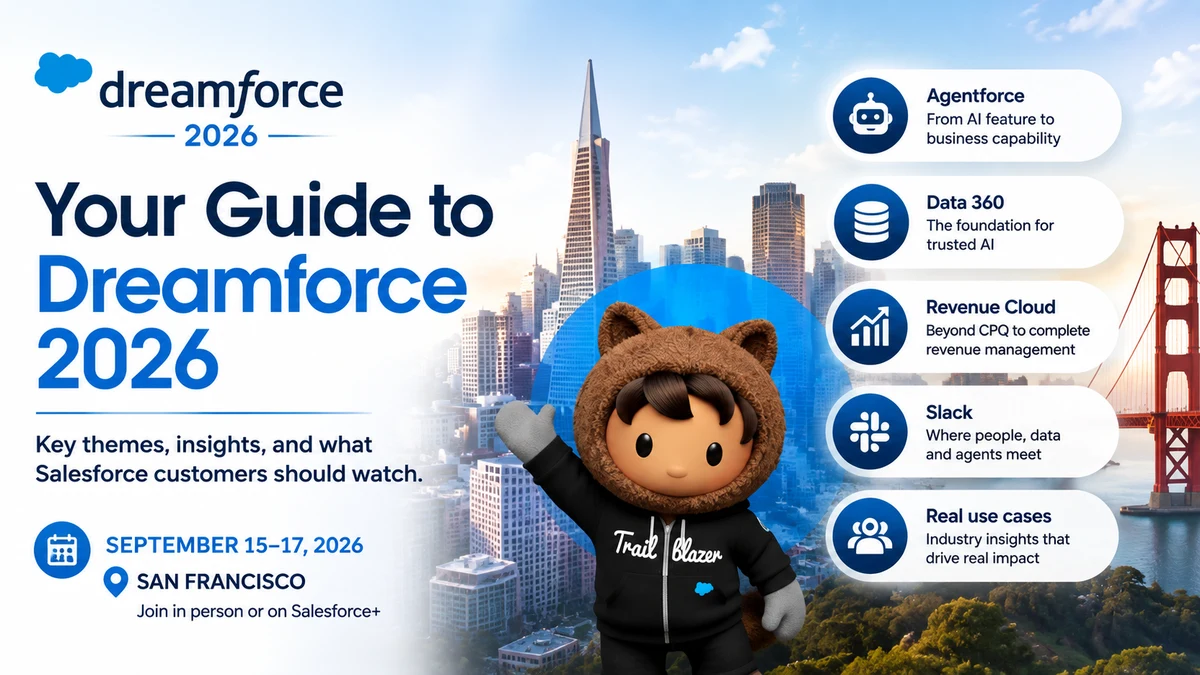
Dreamforce is Salesforce’s flagship annual conference, bringing together customers, Salesforce employees, developers, partners, executives, industry leaders, and the broader Trailblazer community. Dreamforce 2026 takes place September 15–17, 2026, at Moscone Center in San Francisco. Salesforce+ will also provide a free online experience, including keynotes, expert-led sessions, virtual hands-on training, and product demonstrations. The scale is significant:
- 1,600+ breakout sessions
- 50+ visionary and product keynotes
- 150+ hands-on trainings and demos
- 240+ community roundtables
- Product demonstrations and customer experiences across the Salesforce portfolio
- Networking with Salesforce experts, customers, partners, and industry leaders
But the sheer number of sessions is also the problem. You cannot meaningfully consume all of it. The goal should be to identify the announcements and sessions that connect directly to your business priorities.
Why Dreamforce 2026 Matters More Than a Product Launch Event
Dreamforce has traditionally been a place to hear about the next generation of Salesforce products. That is still true. But the bigger story in 2026 is how Salesforce is changing the relationship between CRM, data, AI, automation, and employees. Salesforce’s current positioning centers on the idea of the Agentic Enterprise. The company is building toward a model where AI agents can reason over trusted business information, take actions, and work alongside people across business processes. That creates a more important set of questions for customers:
- Where should an agent actually be used?
- What data does it need access to?
- What actions should it be allowed to take?
- Where does a human still need to make the decision?
- How do you measure whether the agent is producing business value?
Those are architecture and operating-model questions, not simply software questions. That is why Dreamforce 2026 is worth watching closely.
Dreamforce 2026 at a Glance
| What | Details |
|---|---|
| Dates | September 15–17, 2026 |
| Location | Moscone Center, San Francisco |
| Online | Salesforce+ |
| Sessions | 1,600+ |
| Keynotes | 50+ |
| Hands-on trainings and demos | 150+ |
| Community roundtables | 240+ |
| Main themes | Agentforce, Data 360, Slack, CRM, AI, automation, industry solutions and the Agentic Enterprise |
Salesforce’s official agenda continues to evolve, so session counts and specific programming can change as the event approaches.
5 Areas Salesforce Customers Should Watch at Dreamforce 2026
1. Agentforce: From AI Feature to Business Capability
Agentforce is likely to remain one of the biggest areas of attention at Dreamforce 2026. But the useful question is not:
- “What can Agentforce do?”
- It is:
- “Where can an agent take meaningful work off a person’s plate?”
Salesforce has already expanded Agentforce beyond simple conversational experiences. Current capabilities span areas such as sales, service, platform operations, and agent development. Salesforce continues to report broader Agentforce adoption and growth in production use cases. That makes the conversation more practical. For example, a sales organization might ask an agent to:
- Qualify inbound leads
- Prepare account research
- Recommend next steps
- Generate follow-up activities
- Update records after customer interactions
- A service organization might use agents to:
- Resolve common customer questions
- Retrieve relevant information
- Summarize cases
- Recommend actions
- Escalate situations that require human judgment
The real implementation challenge comes next. Agents need access to the right data, clear business rules, appropriate permissions, and defined actions. That means an Agentforce project is not simply an AI project. It can become a data, process, security, and architecture project. That is something Salesforce customers should pay close attention to at Dreamforce.
2. Data 360: The Foundation Behind the Agent
AI is only as useful as the information it can work with. That makes Data 360 one of the most important areas to watch alongside Agentforce. Salesforce has been investing heavily in connecting structured and unstructured data, including through Zero Copy capabilities and additional data connectors. In FY26, Salesforce reported that Data 360 ingested 112 trillion records, including 53 trillion through Zero Copy. The important takeaway is simple: The future of AI on Salesforce depends heavily on access to trusted business context. Consider a customer service agent. A CRM record alone may not tell the full story. The relevant context could also sit in documents, order history, product information, contracts, support content, or external systems. The value comes from connecting that context so the agent can use it appropriately. At Dreamforce, watch for announcements and sessions around:
- Data 360
- Zero Copy
- Unstructured data
- Data governance
- Data quality
- AI grounding
- Data access and security
- How data is made available to agents
For businesses already planning an Agentforce rollout, this may be just as important as the agent itself.
3. Slack: Where Work and Agents Meet
Slack is another area worth watching because Salesforce increasingly positions it as a conversational layer for work and AI. The interesting question is how employees will interact with agents during everyday work. Instead of switching between CRM screens, reports, applications, and messaging tools, employees can increasingly interact with business information and workflows through conversational interfaces. That raises practical questions for businesses:
- Which workflows belong in Slack?
- What information should employees be able to retrieve?
- Which actions should agents be able to initiate?
- How should approvals work?
- How do you maintain security across conversations, CRM data, and automated actions?
Salesforce’s current Dreamforce positioning includes dedicated Slack experiences alongside Agentforce and Data 360. For organizations already using Slack heavily, this is worth putting on the agenda.
4. Revenue Management: Look Beyond Traditional CPQ
For Salesforce customers involved in complex selling, pricing, quoting, subscriptions, or billing, Dreamforce 2026 should also be viewed through a revenue-management lens. The Salesforce revenue stack is changing. Salesforce is moving investment toward Revenue Cloud and its newer Agentforce-powered revenue capabilities, while the traditional CPQ product is approaching the end of its lifecycle for new sales. For revenue teams, the important conversation is therefore not simply whether to replace CPQ. It is understanding what the newer architecture makes possible. That includes areas such as:
- Product catalog management
- Complex pricing
- Pricing waterfalls
- Usage-based and recurring models
- Quote and order processes
- Contract and subscription management
- Billing
- Revenue recognition
- APIs and integrations
- Agent-assisted revenue processes
One of the biggest differences is the ability to treat pricing and revenue processes as connected business logic rather than isolated quoting functionality. For companies running complex CPQ environments, Dreamforce is a good opportunity to ask a more useful question:
- What should our revenue architecture look like over the next three to five years?
That question is more valuable than simply asking what the next CPQ feature is.
5. Industry Solutions: AI Has to Understand the Business
AI does not operate in a vacuum. A financial services organization, manufacturer, healthcare company, and technology company have very different processes, terminology, compliance requirements, and customer interactions. That is why industry-specific Salesforce solutions remain important. At Dreamforce, look beyond generic AI demonstrations. Pay attention to how Salesforce and its customers are applying AI and automation to actual industry workflows. The most useful examples will answer questions such as:
- What process changed?
- What data was involved?
- What did the agent actually do?
- Where was human approval required?
- What business metric improved?
That is where customer stories become more useful than product announcements.
What Agentforce Means in Practical Terms
The phrase “agentic AI” can sound abstract. A simpler way to think about it is this: A traditional automation follows predefined instructions. An AI agent can interpret a goal, use available context, decide which permitted actions are appropriate, and execute those actions within defined boundaries. Imagine a customer submits a service request. A traditional automation might route the case based on a set of rules. An agent could potentially understand the request, retrieve the customer’s history, identify the relevant knowledge, recommend a resolution, update the case, communicate with the customer, and escalate the issue if it falls outside its authority. That is a very different operating model. But it also creates more responsibility around:
- Data quality
- Permissions
- Business rules
- Agent actions
- Human escalation
- Testing
- Monitoring
- Governance
- ROI measurement
- So when evaluating an Agentforce demo at Dreamforce, do not stop at “That looks impressive.”
- Ask:
- Could this work with our data?
- Could this work with our processes?
- What would the agent actually be allowed to change?
- How would we measure success?
Those questions will tell you much more.
Who Should Attend Dreamforce 2026?
Dreamforce is relevant to far more than Salesforce administrators.
Salesforce Administrators
Look for platform updates, automation capabilities, governance improvements, and practical ways to improve the existing org.
Developers and Architects
Focus on architecture, APIs, agent development, data access, integrations, security, and the technical foundations required for AI. Salesforce’s developer programming specifically highlights AI innovation, product launches, hands-on learning, and building smarter applications and agents.
CIOs and Technology Leaders
Look beyond individual features. Focus on platform strategy, architecture, security, data, AI governance, integration, and the long-term Salesforce roadmap.
CROs and Revenue Leaders
Pay attention to Revenue Cloud, sales productivity, pricing, quoting, forecasting, automation, and how AI can change revenue operations.
RevOps Teams
Dreamforce can be particularly useful for understanding how sales, service, data, automation, and revenue processes can work together instead of being managed as separate systems.
Salesforce AEs and Consultants
The value is in understanding what is changing before customer conversations begin. Knowing the product announcement is useful. Knowing which customer problem it solves is much more valuable.
How to Build a Useful Dreamforce Agenda
The biggest Dreamforce mistake is trying to attend everything. With more than 1,600 sessions, that is impossible. Instead, build your agenda around business questions.
Step 1: Start With Your Problems
Before looking at sessions, write down three to five questions your organization is trying to answer. For example:
- How do we modernize our CPQ architecture?
- Where should we introduce AI?
- How do we make customer data more usable?
- How can sales teams spend less time on administration?
- How should our Salesforce architecture evolve over the next three years?
Step 2: Choose Your Three Priorities
Do not create a 30-session wishlist. Pick three areas that matter most. For a revenue organization, that might be:
- Revenue Cloud + Agentforce + Data 360
- For a service organization:
- Agentforce Service + Data 360 + Slack
- For a technical team:
- Agentforce Platform + Data Architecture + Security
Step 3: Mix Strategy With Technical Sessions
Do not spend three days watching keynotes. Balance:
- Executive keynotes
- Product sessions
- Technical sessions
- Hands-on training
- Customer stories
- Roundtables
- Product demos
Salesforce itself recommends finalizing your agenda while leaving room for unexpected opportunities. That is good advice. Some of the most useful conversations may happen outside the session you originally planned.
What Salesforce Customers Should Do Before Dreamforce
Dreamforce becomes much more valuable when you arrive with context.
Audit Your Current Salesforce Landscape
Know what you are running today. Document:
- Salesforce products
- Major customizations
- Integrations
- Data sources
- Automation
- CPQ or revenue architecture
- Current AI initiatives
- Major pain points
Create a “Questions for Salesforce” List
Turn your challenges into specific questions. For example:
- “How does this capability work with our existing revenue architecture?”
- is much more useful than:
- “Tell us about the new AI features.”
Identify the Announcements That Could Change Your Roadmap
Not every new feature deserves attention. Focus on announcements that could affect:
- Your architecture
- Your product roadmap
- Your licensing decisions
- Your data strategy
- Your automation strategy
- Your operating model
That is where Dreamforce can influence actual business decisions.
What to Do After Dreamforce
The real value of Dreamforce starts after you return. Within a week, turn your notes into three categories:
1. Act Now
Features or capabilities that solve an existing problem.
2. Evaluate
Capabilities that could materially improve your architecture or operating model but need testing.
3. Watch
Announcements that are interesting but not mature or relevant enough to act on yet. Then map each item to a business outcome. For example:
- Dreamforce announcement → business problem → Salesforce capability → required changes → expected impact
That creates a roadmap instead of a collection of conference notes.
The Bigger Question for 2026
The most important thing to watch at Dreamforce may not be a single product announcement. It is the direction of the Salesforce platform. Salesforce is increasingly bringing CRM, data, AI agents, collaboration, automation, and business applications closer together. The result is a shift in how companies should think about Salesforce. It is no longer enough to ask:
- “Which Salesforce product should we buy?”
- The better question is:
- “How should our business processes work, and what role should Salesforce play in running them?”
That shift has consequences for architecture, data, security, operating models, integrations, and revenue processes. And that is where Dreamforce becomes genuinely useful.
Stack Intelligence Takeaway
Dreamforce 2026 will have plenty of announcements. The challenge will be separating what is new from what actually matters. For Salesforce customers, three questions should sit at the center of the conversation:
- What can we automate?
- What data do our people and agents need to make better decisions?
- What should our Salesforce architecture look like next?
If you can answer those questions before you arrive, you will get much more from Dreamforce. Because the goal is not to come back with a longer list of Salesforce features. The goal is to come back with a clearer roadmap.


