Stock Counts Don't Match Across Channels
Your website says a jacket is in stock. But the last one left the store an hour ago. Your POS and your site each go by their own count. Shoppers get let down, and after a while your staff ignore both.

Someone orders a jacket on your site, then walks it back into a store a week later. The store can't see the online order. Meanwhile, a member at a local gym calls to book a spin class. That booking never makes it into the CRM. We're Stack Intelligence. Our job is setting up Salesforce for retail and consumer services. When we're done, your staff can pull up any order, booking, or chat from one customer record.
Logos of Texas Instruments, American Express, Fiserv, Autodesk, Target, Honeywell, Dell and Delta Air Lines have worked with Stack Intelligence on Salesforce.







The retail and service brands we meet usually sell in more places than their systems were built for. A typical setup has a website and a few stores. Then there's a wholesale channel, plus a phone line for bookings. Here's where things usually break.
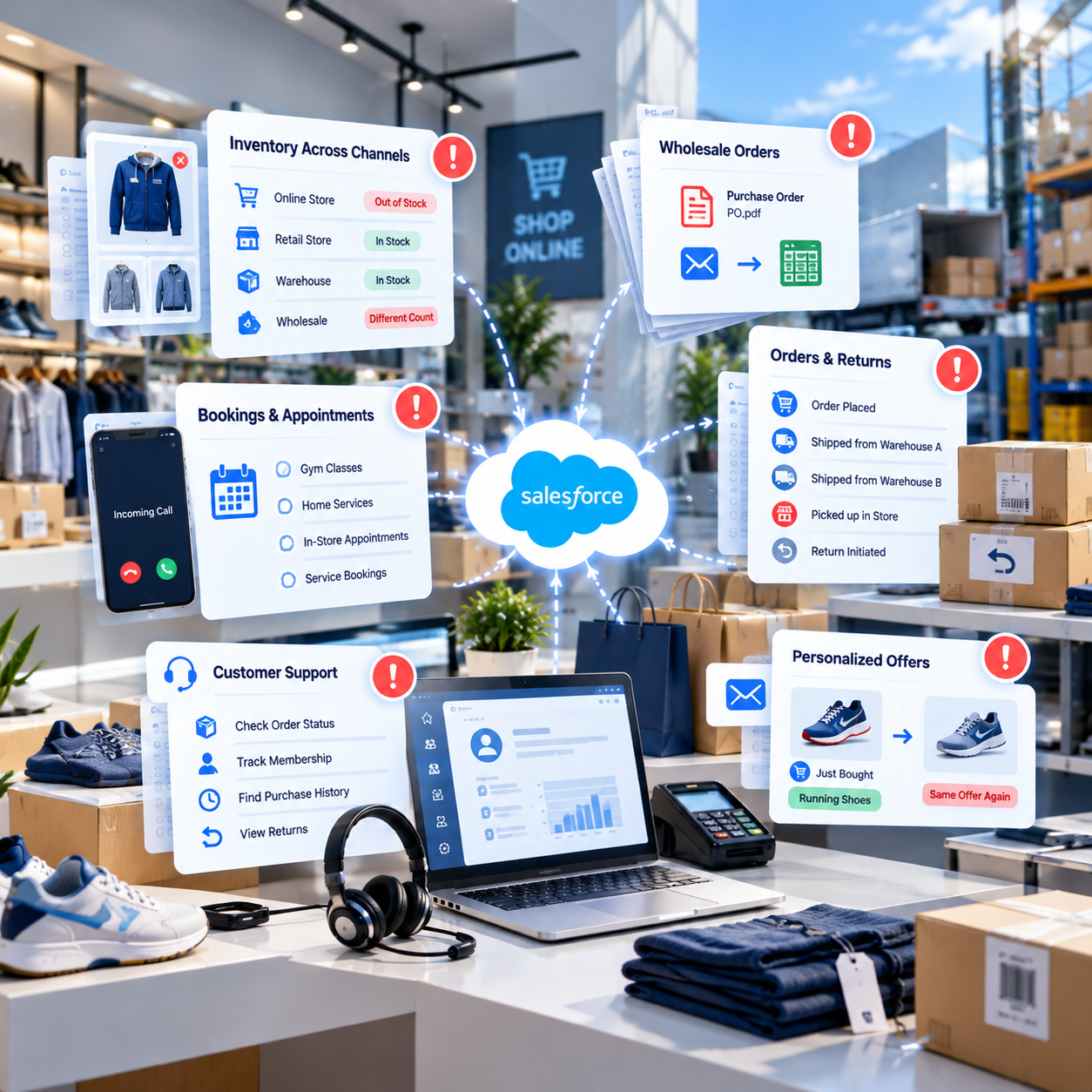
Your website says a jacket is in stock. But the last one left the store an hour ago. Your POS and your site each go by their own count. Shoppers get let down, and after a while your staff ignore both.
Your wholesale buyers still send purchase orders as PDFs. Someone on your team types each one in by hand. One wrong SKU means a wrong shipment and then a credit. Your account managers spend the week fixing orders.
One order ships from two warehouses. The customer grabs half of it at the store and mails one piece back later. Somebody on your ops team logs every step in a spreadsheet. Fixing the mix-ups eats half their week.
A gym member wants to move a class. Down the road, a homeowner needs the dishwasher fixed. Both call, sit on hold, and end up with a time scribbled on a sticky note. Without a reminder, many never show.
A customer calls to ask where their order is, or why their membership renewed twice. The agent logs in to three systems to find out. The customer stays on hold the whole time and gets more annoyed by the minute.
Someone bought running shoes yesterday and gets a coupon for running shoes today. A member of five years gets the same email as a first-time visitor. Your marketing tools don't know who people are or what they bought.
Each problem above has a fix below. For most brands in the retail industry, the work starts with Salesforce Commerce Cloud. Service businesses usually start with Service Cloud and a booking portal. After that, we hook Salesforce into the tools you're already using.
Your storefront gets built on Salesforce Commerce Cloud. We link it to the POS, ERP, and inventory tools you use now, through MuleSoft or APIs. When a jacket sells in the store, the website count drops too. Data 360 also ties online and in-store purchases to the same shopper.
With Salesforce B2B Commerce, each wholesale buyer gets a store of their own. Their contract prices are already loaded, and reordering last month's order takes a few clicks. Each order goes straight into Salesforce and your ERP, so nobody on your team has to retype a purchase order again.
When an order comes in, Salesforce Order Management decides which warehouse or store ships it. An order can ship from two places. Customers can also pick up in store, or send items back by mail or at the counter. Your ops team can check any order's status from one screen.
Customers book on their own through a portal we build on Experience Cloud. One reserves a yoga class, another books a plumber for Saturday. The night before, they get a reminder. Home service companies also use Field Service to send whichever technician is nearby and has the parts. Each visit lands on the customer record.
Someone calls because their package is late, or they got charged twice. With Service Cloud, the agent already has that person's orders, bookings, and past cases open. Quick questions about order status or store hours can be handled by a help page or an Agentforce agent.
Before Marketing Cloud sends an email, it looks up the customer's purchases in Data 360. A guy who bought running shoes last week hears about socks this week. Loyalty Management adds points every time someone comes back. Agentforce agents can answer product questions on your site and help members book.
Which problem hurts most right now? Maybe it's stock counts, or wholesale orders, or bookings. Give us 25 minutes. We'll sketch how Salesforce for retail would handle it with the systems you already have.
Pick a cloud and see what we built, for whom, and what changed after go-live.
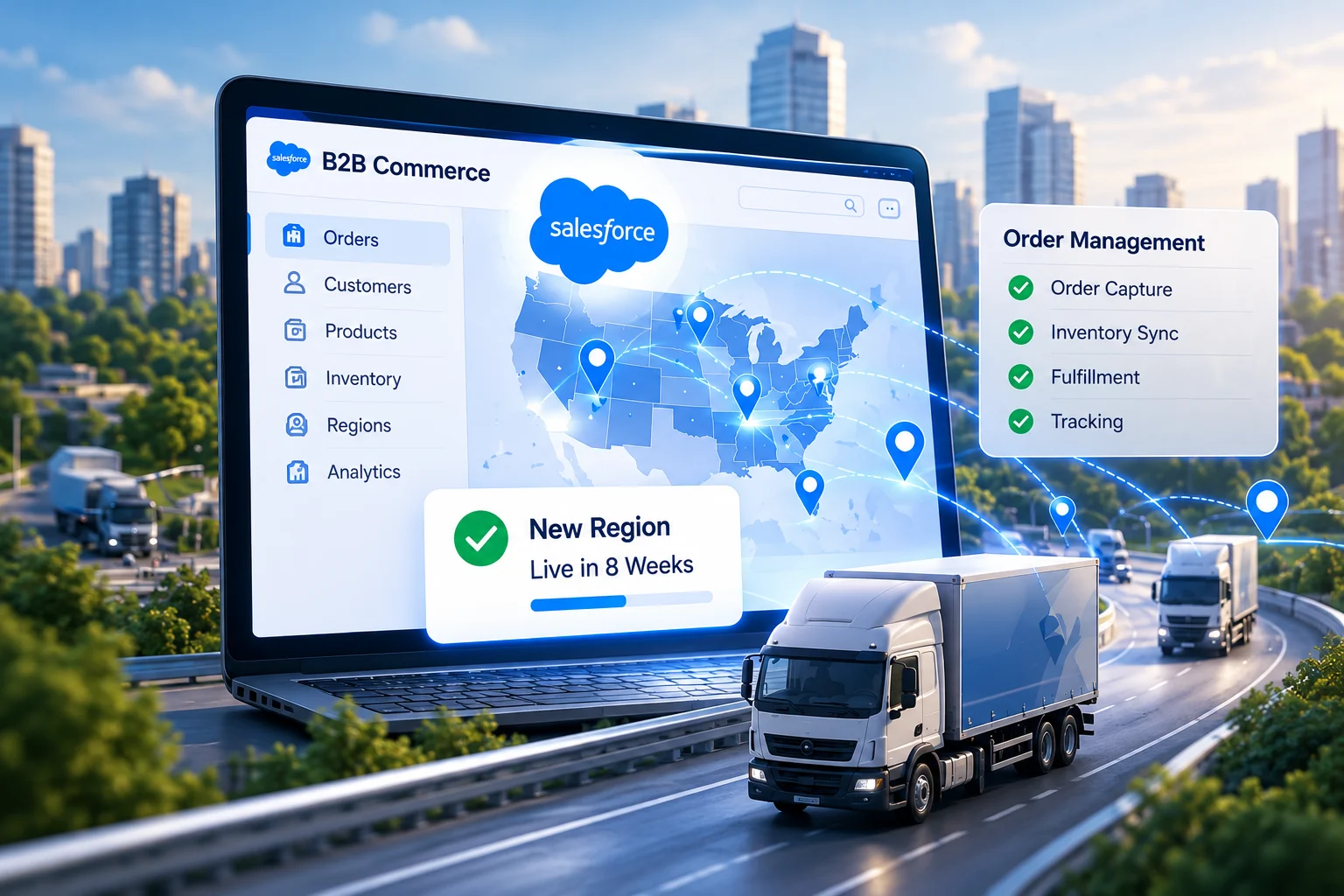
Industry: Mobility & Accessibility
The problem
Demand was outgrowing spreadsheet-and-email ordering, and each new region took months to open.
What we did
Built a B2B Commerce storefront with Salesforce Order Management and automated ordering end to end.
Result
Live in 8 weeks. New regions now open in 1–2 weeks, down from 4–6 months.
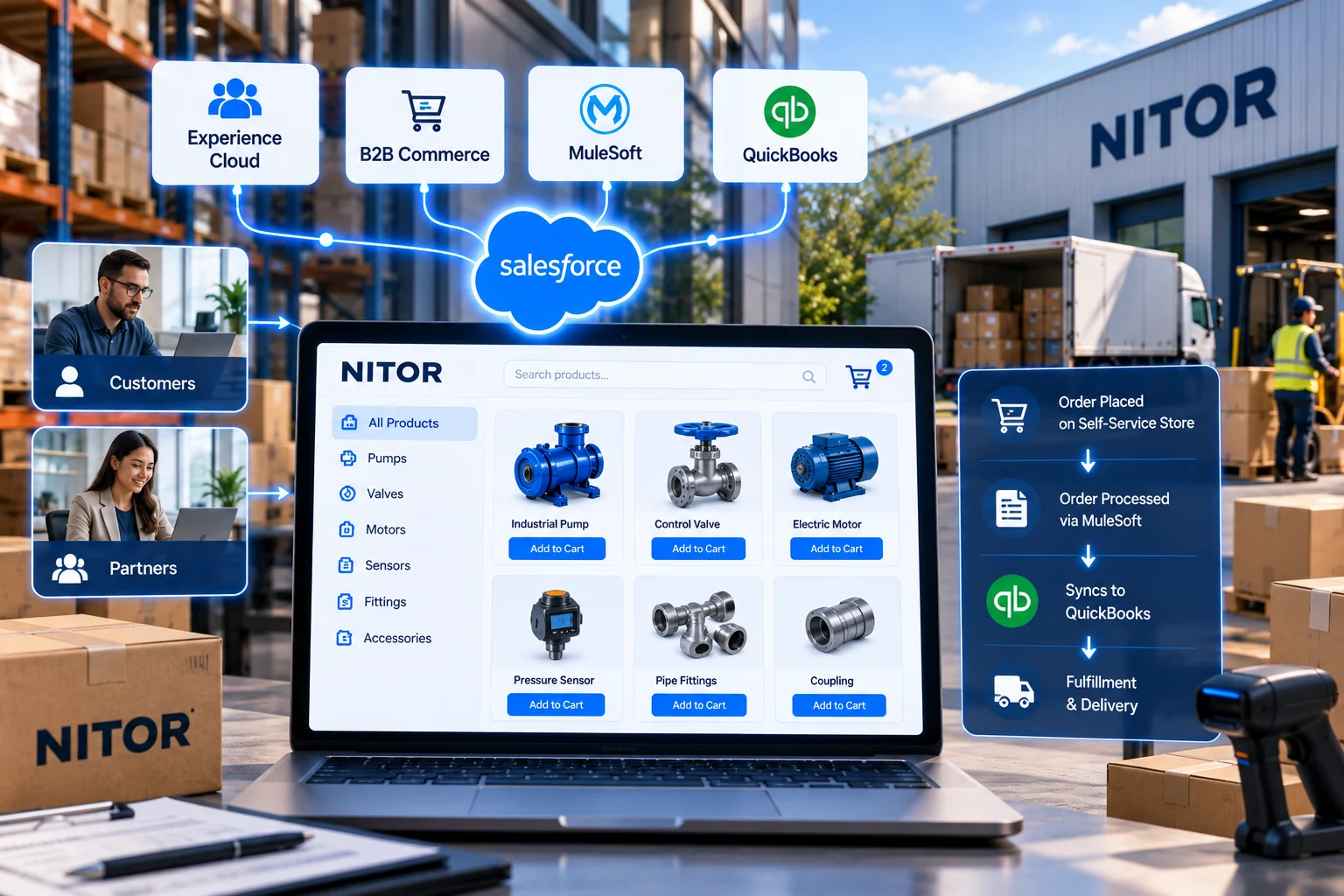
Industry: Physical Security & Surveillance

The problem
A growing partner network meant more small accessory orders landing on the sales team’s desk.
What we did
Launched a self-service storefront on Experience Cloud and B2B Commerce, with MuleSoft syncing orders to QuickBooks.
Result
Customers and partners now order on their own, and the channel scales without extra headcount.
Clients rate Stack Intelligence 5/5 on Salesforce AppExchange, and these four quotes came in after their projects wrapped.
Showing testimonial 1 of 4: Vince Tan, Director of IT, Ascensus Specialties


Our retail and consumer services projects follow seven steps. We kick off by following one real order or booking all the way through. Each step needs your OK before we start on the next.
Choose any recent order or booking. We'll walk it from the first click to the moment it reaches the customer, and ask questions of every team along the way.
We look at your ecommerce platform, POS, ERP, and booking tools. If you already use Salesforce, we go through that org and its settings too.
This is where we sketch out the data model. Your products and prices go in, along with customers, members, and wholesale accounts. If you sell B2B, contract prices and buyer roles get worked out now too.
All the building happens in a sandbox. We lean on what Commerce Cloud and Service Cloud do out of the box, and write code only for the gaps. Your team gets to try a demo after each sprint.
Your POS, ERP, warehouse, and booking links go live in a test environment. Meanwhile, we clean up product and customer data and run a trial load.
Our team runs real orders through checkout, splits shipments, handles returns, and books test visits. Then your merchandisers and service team try everything themselves.
We plan go-live away from your peak season so nothing breaks during a rush. After launch, we stay on through hypercare and ongoing support.
Our first few weeks with you are mostly questions. Which channel makes you the most money? Who decides wholesale prices? What does your team do when a package is late or a member quits? Your answers decide what we build.
Hire Salesforce ConsultantsWe've built Salesforce B2B Commerce stores connected to MuleSoft and QuickBooks, and ordering sites on Salesforce Commerce Cloud. We know where standard features fit and where custom work pays off.
We schedule every go-live around your busy seasons. Your site and booking tools won't change in the middle of a holiday rush or a January membership surge.
When your storefront and POS show different prices, every other tool inherits the mess. So we connect your storefront, POS, ERP, and booking tools before anything else. Everything after that runs on numbers your team can trust.
Agentforce gives better answers when your product, order, and customer data is clean. We clean it up while we build. Later, turning on an agent is a much smaller job.
The architects, developers, admins, and analysts on your project all come from our own team. The people with the certifications build your org themselves and stay on to support it.
Your business keeps changing after launch. New products come in, prices move, and sometimes a new location opens. Our Salesforce managed services keep your store, portals, and service tools running smoothly every week.
Salesforce for retail is a set of Salesforce products for stores and brands. They use it to sell, to ship orders, and to help customers once the sale is done. The online store itself runs on Commerce Cloud. Order Management handles shipping and returns. Support happens in Service Cloud, and email goes out through Marketing Cloud. They all pull from one customer record.
In the retail industry, Salesforce mainly runs online stores and holds customer records. Shoppers buy through Commerce Cloud. Order Management then works out where each order should ship from. Questions get answered in Service Cloud. For wholesale, there's Salesforce B2B Commerce, where trade buyers place their own orders.
No, Salesforce doesn't sell a product called Retail Cloud. People who search for Salesforce Retail Cloud, or retail cloud Salesforce, usually mean Commerce Cloud. Some mean Consumer Goods Cloud, which helps brands that sell through other retailers' stores.
Salesforce Commerce Cloud runs online stores. Salesforce offers B2C, B2B, and direct-to-consumer versions. A retail team uses it to manage products, plan promotions, and handle checkout. If you sell in more than one country, each site can have its own language and currency.
Yes, it's the same product. Salesforce renamed it Agentforce Commerce in late 2025. The old name returned in 2026. A few Salesforce pages still say Agentforce Commerce.
Salesforce B2B Commerce is how you sell online to other businesses, like dealers and wholesale buyers. Each wholesale customer logs in to a store that shows their own contract prices. They can reorder from past orders and pay on account. Their orders land in Salesforce automatically, and your team doesn't have to key them in.
Yes. Salesforce for ecommerce is built on Commerce Cloud. You can run a consumer site and a wholesale site on it, or just one of them. Order Management, Service Cloud, and Marketing Cloud can be added whenever you're ready.
Lots of retailers already run on Salesforce. As a Salesforce retail CRM, it holds a shopper's orders and returns. Bookings and support cases sit on that same record. Marketing, the store, and the service desk all work from it.
Salesforce retail customers include fashion labels, specialty chains, and consumer goods makers. Some manufacturers and distributors sell to dealers through B2B Commerce. Service businesses use it too. A gym might use it for memberships. So might a salon, a travel company, or a home repair business taking bookings.
With Salesforce, customers can book or change a visit through an Experience Cloud portal. They get a reminder a day ahead. Home service companies add Field Service to send the right technician. Every booking and conversation ends up on the customer's record in Service Cloud.
Yes. We use MuleSoft or APIs to connect it with your POS, ERP, and warehouse systems. Stock, prices, and orders then match on your website and in your stores.
Commerce Cloud pricing is usually a percentage of the sales that go through your store. Salesforce calls that number gross merchandise value, or GMV. Implementation is a separate cost. One storefront costs less than several brands with POS and ERP links. We give you a number after discovery.
It comes down to the size of the build. One B2C or B2B store might go live in a few months. If you're moving several brands and connecting a POS and ERP, plan on more time. We also plan around your peak season, and you get a real timeline after discovery.
Tell us where you sell and how customers book with you today. We'll show you how Salesforce Commerce Cloud and Service Cloud would bring your site, stores, and bookings onto one record.