Quotes Take Days
Your rep is pricing 200 seats with a support add-on and a special discount. The quote bounces from finance to legal and back again. By day three, the buyer has signed with a faster vendor.

Sales closed the deal in March. Billing heard about it in April. Support met the customer in May, during an outage. Stack Intelligence sets up Salesforce for high tech companies so every team sees the same account from day one.
Logos of Texas Instruments, American Express, Fiserv, Autodesk, Target, Honeywell, Dell and Delta Air Lines have worked with Stack Intelligence on Salesforce.








Tech companies sell fast and bill in complicated ways. Most CRMs handle the early years fine. Then pricing gets more complex, quotes start crawling, and finance ends up patching spreadsheets every Friday.

Your rep is pricing 200 seats with a support add-on and a special discount. The quote bounces from finance to legal and back again. By day three, the buyer has signed with a faster vendor.
Thirty days before a major renewal, someone on the team finally sees the reminder email. The account manager panics. To keep the customer, she offers a steep discount, and the margin you'd counted on is gone.
Customers pay by seat, by usage, or both. Product data shows one number. Billing shows another. Finance spends the last week of every month fixing invoices by hand before any of them go out.
Your resellers find deals you never hear about until later. Some send a registration email. Others don't bother. Then two resellers show up at the same customer, and you're the one sorting out the fight.
An enterprise customer opens a ticket about an outage. The support rep can't see that the account renews next month or that sales is mid-expansion. One rough reply from support puts a big deal at risk.
Sales reports one ARR figure. Finance reports another, and the board deck shows a third. Every team trusts its own tool. So each planning meeting opens with a long debate about whose number is right.
Each problem above has a fix below. Salesforce doesn't sell a single High Tech Cloud. We use four of its products for this: Sales Cloud, Revenue Management, Service Cloud, and Experience Cloud. Then we hook them up to your product and finance tools.
A buyer on the phone asks for 200 seats and premium support. Your rep prices it all in Salesforce Revenue Management, discount and all, while they're still talking. Anything outside the normal rules goes to an approver on its own. Simple deals go out the same day they're asked for.
Each contract carries its renewal date, and alerts go out at 120, 90, and 60 days ahead. On the same page, customer success can check usage and any open tickets. They walk into renewal talks ready to grow the account.
Your product might meter API calls or active users. Either number flows into Salesforce over MuleSoft or an API. Revenue Management adds it to the seat charges on the invoice, and Avalara works out the tax. Customers get invoices that match what they used, and month-end gets quiet.
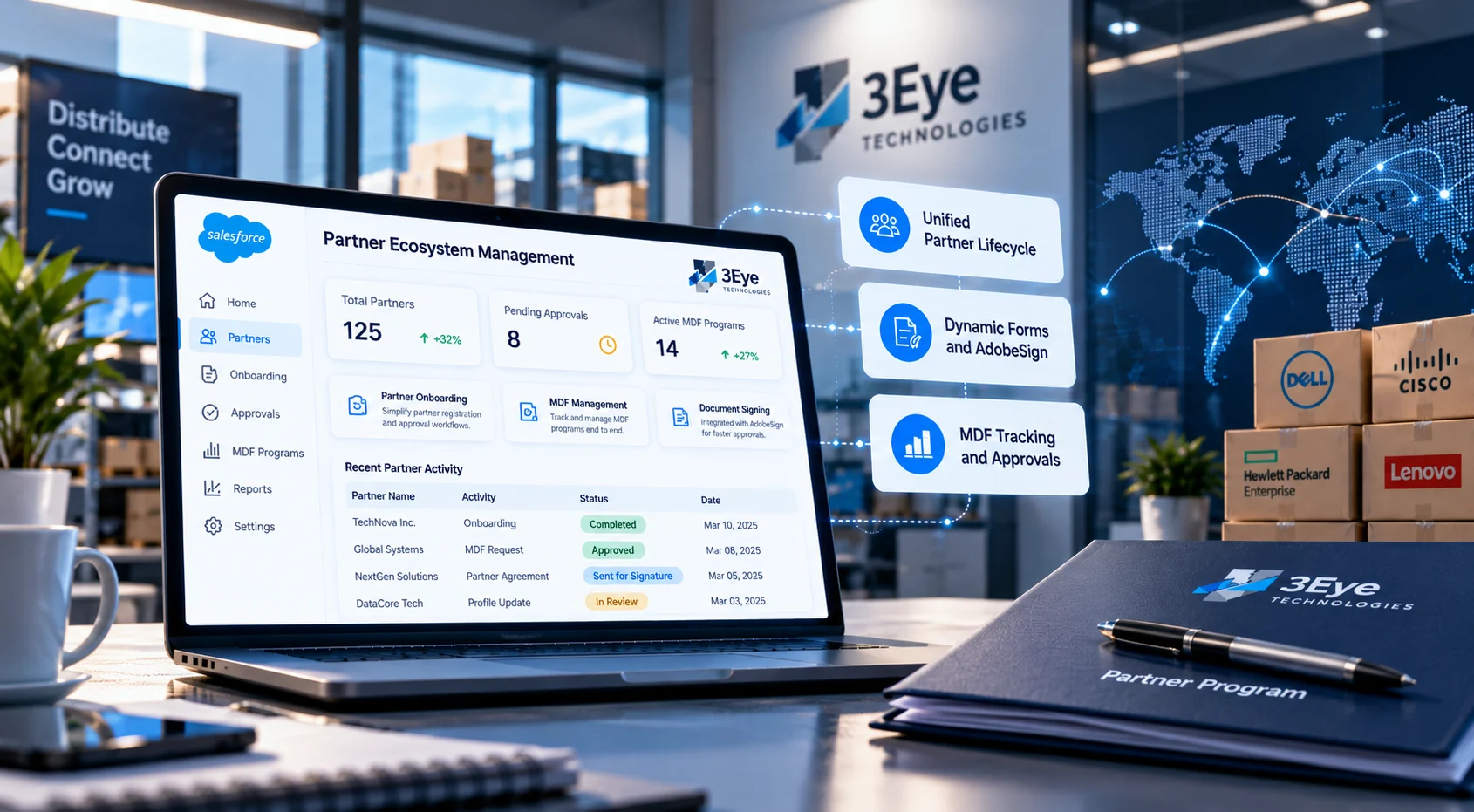
Resellers register deals, download pricing, and track commissions in a portal we build on Experience Cloud. Each deal gets one owner the moment it's registered. Your channel team sees every partner's pipeline without chasing anyone for spreadsheets.
A support rep in Service Cloud can tell at a glance that this account renews next month and has an expansion deal open. Your largest customers' tickets skip the general queue and land with senior staff. Agentforce answers simple how-to questions from your help center any time.
Sales, finance, and customer success stop keeping separate spreadsheets. ARR, churn, and pipeline sit on a single dashboard that all three trust. Board prep shrinks to an afternoon, and planning meetings get to the decisions faster.
Is it slow quotes? Missed renewals? Invoices that never match? Pick one. In 25 minutes, we'll show you how Salesforce would handle it with the product and finance tools you already use.
Pick a cloud and see what we built, for whom, and what changed after go-live.
Industry: Mobility & Accessibility

The problem
Demand was outgrowing spreadsheet-and-email ordering, and each new region took months to open.
What we did
Built a B2B Commerce storefront with Salesforce Order Management and automated ordering end to end.
Result
Live in 8 weeks. New regions now open in 1–2 weeks, down from 4–6 months.

Industry: Physical Security & Surveillance

The problem
A growing partner network meant more small accessory orders landing on the sales team’s desk.
What we did
Launched a self-service storefront on Experience Cloud and B2B Commerce, with MuleSoft syncing orders to QuickBooks.
Result
Customers and partners now order on their own, and the channel scales without extra headcount.

Clients rate Stack Intelligence 5/5 on Salesforce AppExchange, and these four quotes came in after their projects wrapped.
Showing testimonial 1 of 4: Vince Tan, Director of IT, Ascensus Specialties




























There are seven steps in each project. We begin by tracing one real deal from its first quote to its first renewal. Nothing moves on until your team approves.
Choose an account you closed last year. Starting at the first demo, we follow it all the way to its latest support ticket. Along the way, we talk with each person who touched it.
We take stock of your current CRM, billing setup, product data, and help desk. Using Salesforce already? Your org, its CPQ setup, and its sharing rules get a review too.
Now the data model comes together. We decide how accounts, contracts, subscriptions, usage, and partner records connect. We also agree early on who can see pricing and discounts.
We build in a sandbox, away from your live org. Out of the box, Revenue Management covers most of what you need. We code the rest. At the end of each sprint, your team clicks through a live demo.
Usage feeds, your ERP, and tax tools go live in a test environment. Meanwhile, we clean up account and contract data and do a trial load.
We quote a deal, renew a contract, bill for usage, and register a partner deal. Then your reps, finance team, and support staff try it themselves.
We launch with one team. Others come on board once that group is comfortable. We stay through hypercare and keep supporting you after that.
Our first questions are about how money flows through your company. How do you price? Who approves a discount? How does a usage spike end up on an invoice? Those answers shape the build.
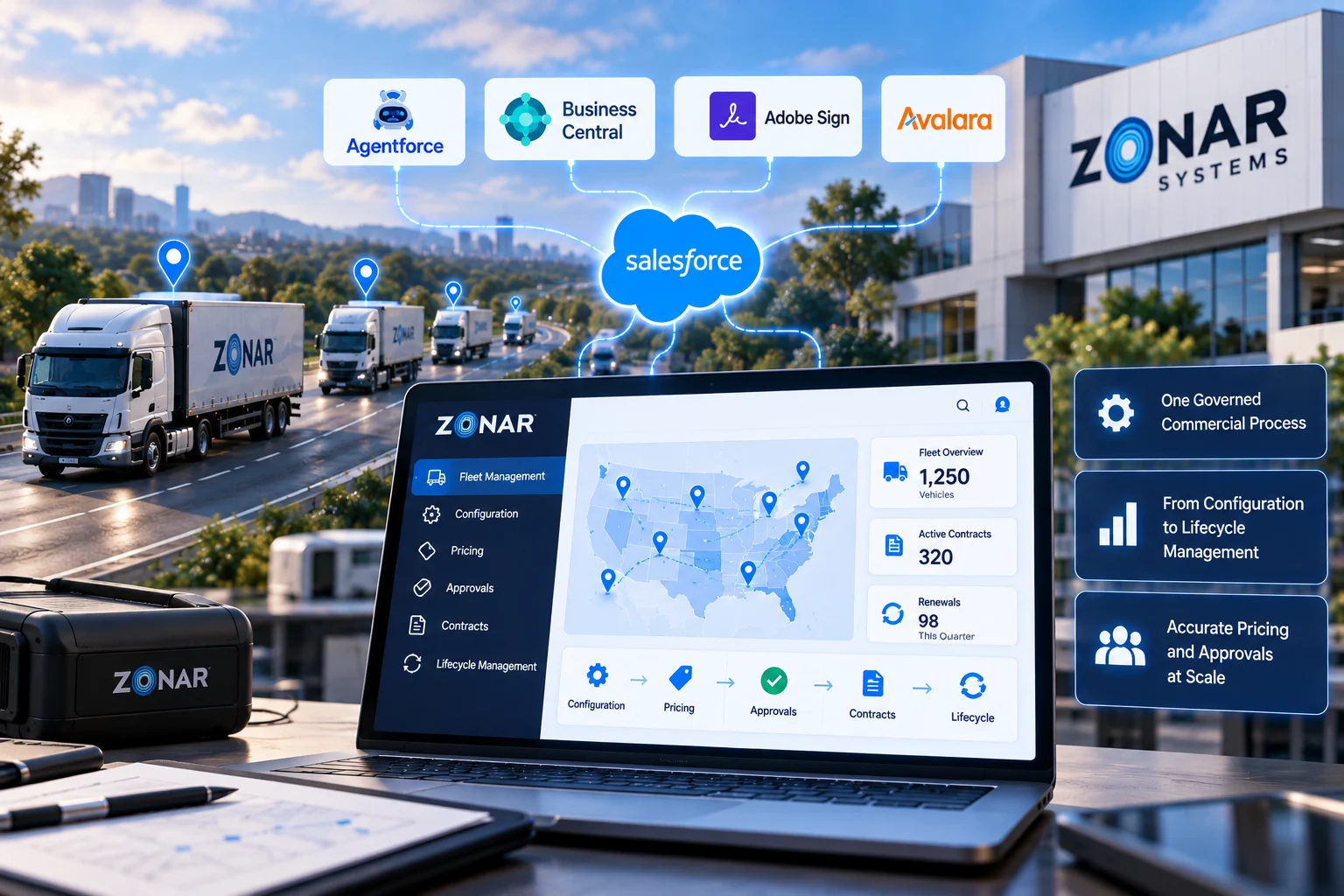
Hire Salesforce ConsultantsFor Zonar Systems, a fleet tech company, we set up Revenue Management with Business Central, Avalara, and a VIN lookup tool. We stayed on for six months of managed services after launch.
NITOR's B2B Commerce store is one we built, linked to QuickBooks through MuleSoft. When an order comes in, the pricing and invoice flow through by themselves. Nobody retypes anything.
Brave Mobility was live eight weeks after our kickoff call. If your market is moving fast, we plan the project to keep up.
Discount rules and pricing data need tight control. Before building, we agree with finance on who sees which prices and who signs off on discounts.
We don't farm the work out. The certified consultants who set up your org stay with you once it's live.
Your product line grows, pricing shifts, and partners come and go. Our Salesforce managed services keep your org in step as your company grows.
You won't need to explain ARR, usage pricing, or why your partners fight over accounts. Our consultants work with tech companies all the time, so the first call can be about your setup.
Salesforce for the high tech industry describes how tech firms, whether they sell software, hardware, or IT services, manage revenue in Salesforce. A deal moves from quote to invoice to renewal without leaving it. Partner deals and support fit in too. Most of it runs on Sales Cloud and Revenue Management.
No. Salesforce doesn't sell one product by that name. A search for Salesforce high tech solutions usually points to Sales Cloud, Revenue Management, Service Cloud, and Experience Cloud used together. That's the setup we build.
Most of the time, it is. In Salesforce for high tech, a customer's seats, subscriptions, and usage share a single record. Startups tend to switch once their billing gets too messy for a lighter CRM.
In the tech industry, reps live in Salesforce, working their pipeline and sending quotes. Finance logs in to the same system to keep an eye on subscriptions and usage. Support handles tickets in Service Cloud, while resellers register their deals through a portal.
Yes, it's the same product family. In late 2025, Salesforce changed the name from Revenue Cloud to Agentforce Revenue Management. Reports from 2026 say Salesforce switched back. Expect to see both names in docs and on sales calls.
Yes. Once MuleSoft or an API links your product to Salesforce, usage is counted without anyone touching it. Those charges then show up on one invoice with the customer's seats and subscription.
Yes. We give every reseller a login to a portal on Experience Cloud. From there, partners register deals, find current pricing, and see their commissions. Your channel managers get one view of every partner's pipeline.
Yes. Product databases, ERPs like Business Central or NetSuite, and tax software such as Avalara can all be connected to it. We pick the connection method after seeing your setup.
Yes. One Agentforce agent could pull answers from your help center for customers. Another might screen new leads, or give a rep a quick summary before a renewal call. We usually start with one agent your data can support.
There are two parts: licenses and implementation. License prices are on Salesforce's website. Implementation costs more as your pricing gets complex and you connect more systems. A simple quote setup costs less than full usage billing. We give you a number after discovery.
Scope drives the timeline. If you start with quoting and billing only, you could be live in a few months. Each extra piece, like usage billing or a partner portal, adds time. You get a real timeline after discovery.
Show us how you quote, bill, and renew today. We'll walk you through how Salesforce for high tech would bring it onto one record, with the right pricing controls from day one.