Quoting Depends on One Person
The rules for what fits with what usually live with one senior engineer or in a spreadsheet nobody wants to touch. That person takes a week off, and quoting grinds to a halt.

Salesforce CRM for manufacturing that connects quoting, orders, and service in one place, helping manufacturers move beyond disconnected systems, reduce reliance on manual processes, and manage everything from engineering-led quotes to ERP orders and warranty claims with Stack Intelligence.
Logos of Texas Instruments, American Express, Fiserv, Autodesk, Target, Honeywell, Dell and Delta Air Lines have worked with Stack Intelligence on Salesforce.






Manufacturers often have plenty of software, but their systems don't share the same information. That leaves sales, finance, and production working from different spreadsheets, creating delays from quoting to forecasting.

The rules for what fits with what usually live with one senior engineer or in a spreadsheet nobody wants to touch. That person takes a week off, and quoting grinds to a halt.
Every big account has its own price list. Add volume breaks and the odd handshake discount, and nobody's quite sure what anyone is paying. Margin leaks out, and nobody can say exactly where.
A rep wins the deal in the CRM. Then someone in ops copies it into the ERP, line by line. Every rekey is another chance for a wrong part number or a missed ship date.
Channel partners can't see pricing, stock, or order status without calling your team. Small reorders eat sales time that should go to bigger deals.
When a machine goes down, the install date is in one place, the warranty terms in another, and the repair history in someone's email. Techs spend the start of every call piecing it together.
Sales forecasts one number. The plant schedules to another. Plants end up building to guesses instead of real demand.
We match each manufacturing challenge with the right Salesforce solution, from CPQ and Revenue Management to Commerce, Service, and Agentforce, integrated with your existing ERP and finance systems.
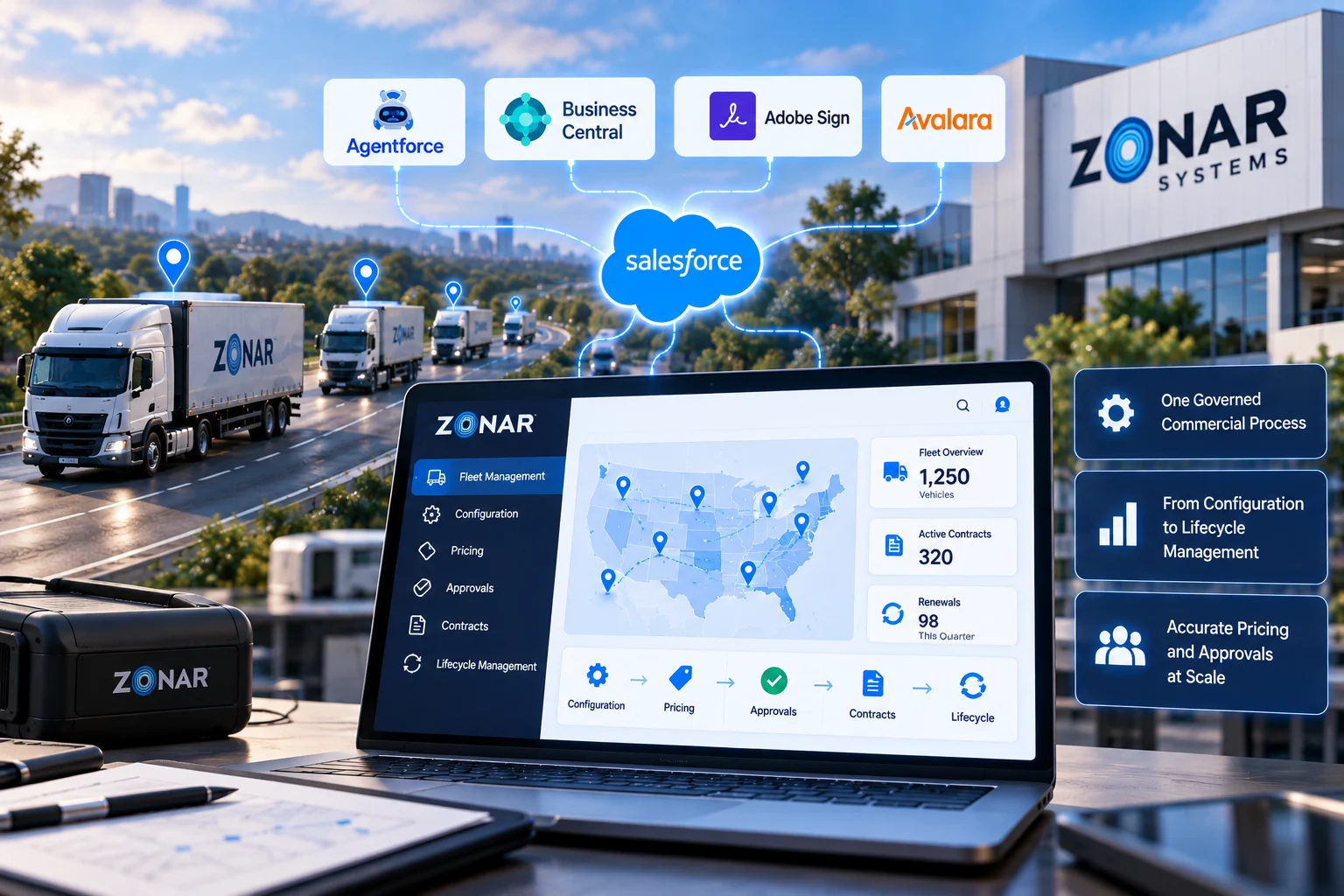
With Salesforce CPQ for manufacturing, those engineering rules move out of someone's head and into the quote screen. Reps simply can't pick a combination the plant can't build. Zonar Systems quotes this way today, with VIN-driven configuration checking compatibility on every line.
Every price list, contract rate, and approval limit sits in one place: Agentforce Revenue Management (formerly known as Revenue Cloud). Any discount over the limit goes to the right approver before the quote goes out.
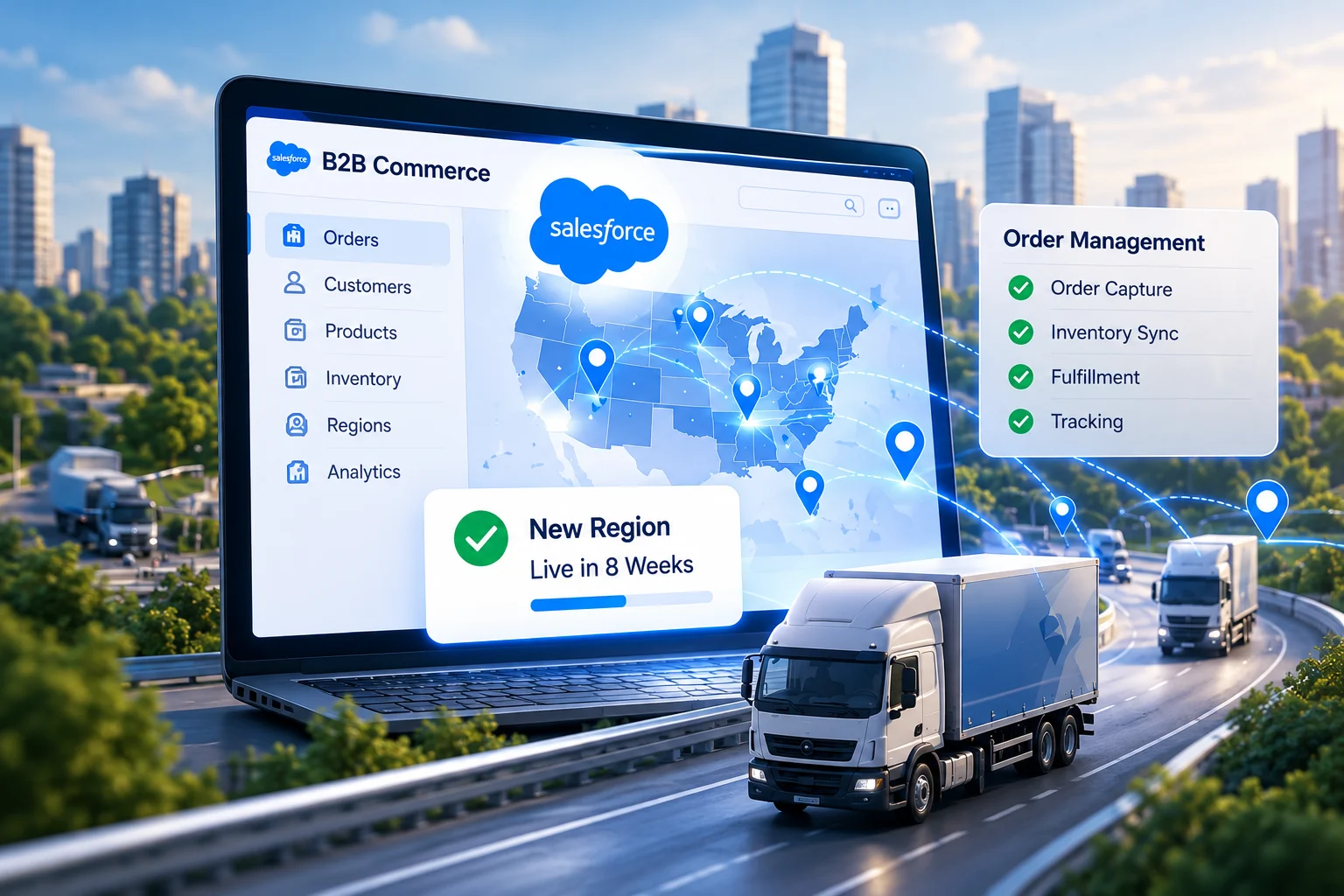
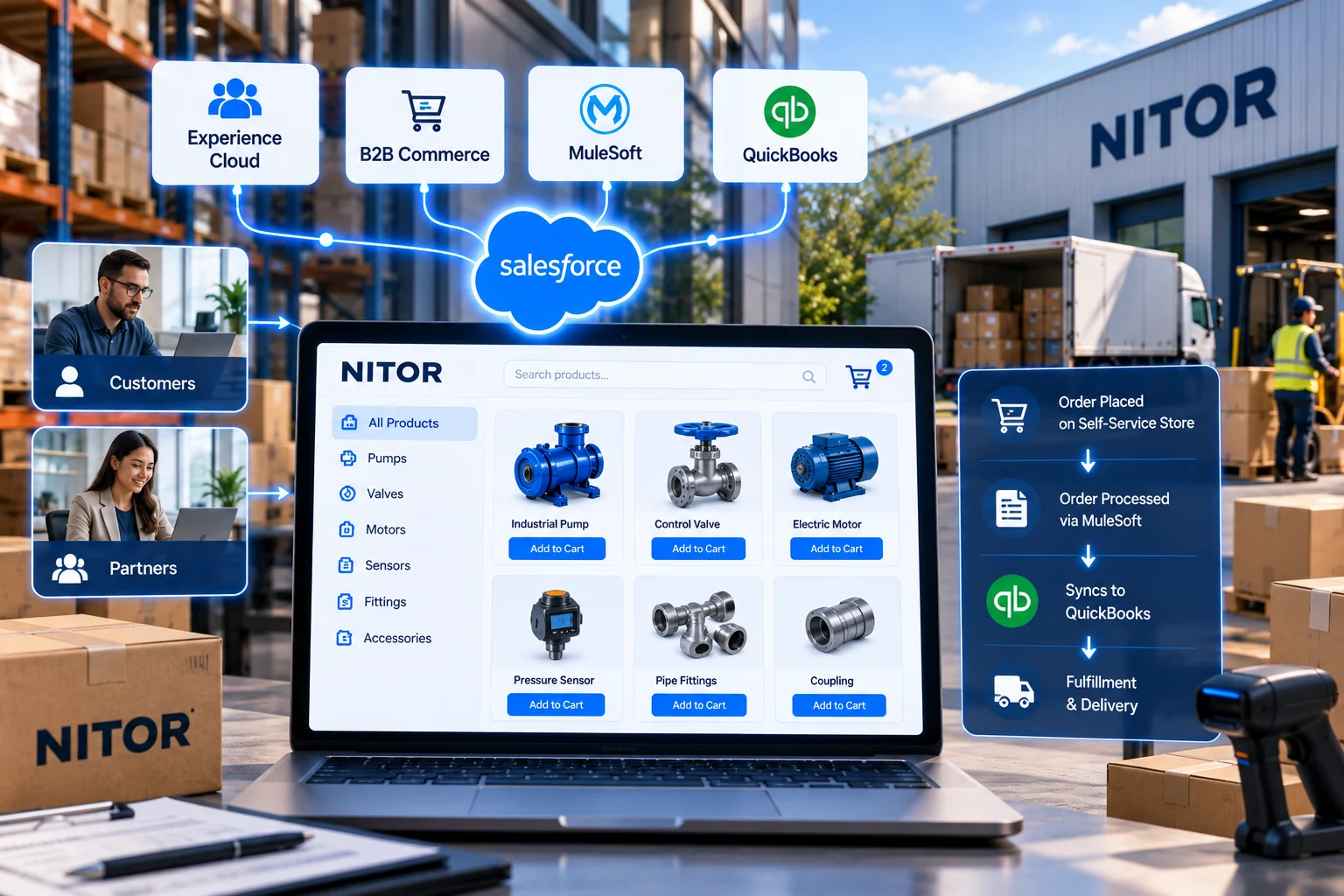
Salesforce gets plugged into your ERP, MES, and finance systems, usually over MuleSoft or straight API calls. A signed quote shows up in the ERP as an order with nobody touching a keyboard. Zonar's orders flow into Business Central, and NITOR's sync to QuickBooks.
Your distributors log into their own portal (Experience Cloud and B2B Commerce under the hood) to look up prices, reorder parts, or see where a shipment is. Nobody has to call your inside sales team for it. NITOR moved its accessory and replacement-part orders there.
Service Cloud gives every machine a single record, from install date to the last repair. Layer on Agentforce Manufacturing (formerly Manufacturing Cloud), and warranty programs, claims, and coverage get tracked there too.
Salesforce CRM for manufacturing starts with Sales Cloud. Add Agentforce Manufacturing's account-based forecasting, and the numbers come from signed agreements and real orders, which is what the plant needs to schedule against. Agentforce can also spot accounts going quiet and draft a nudge for the rep.
Which of those problems hurts most? Give us 25 minutes. We'll sketch how Salesforce for manufacturing would fix it, using your own products and systems.
Pick a cloud and see what we built, for whom, and what changed after go-live.
Industry: Manufacturing & Services

The problem
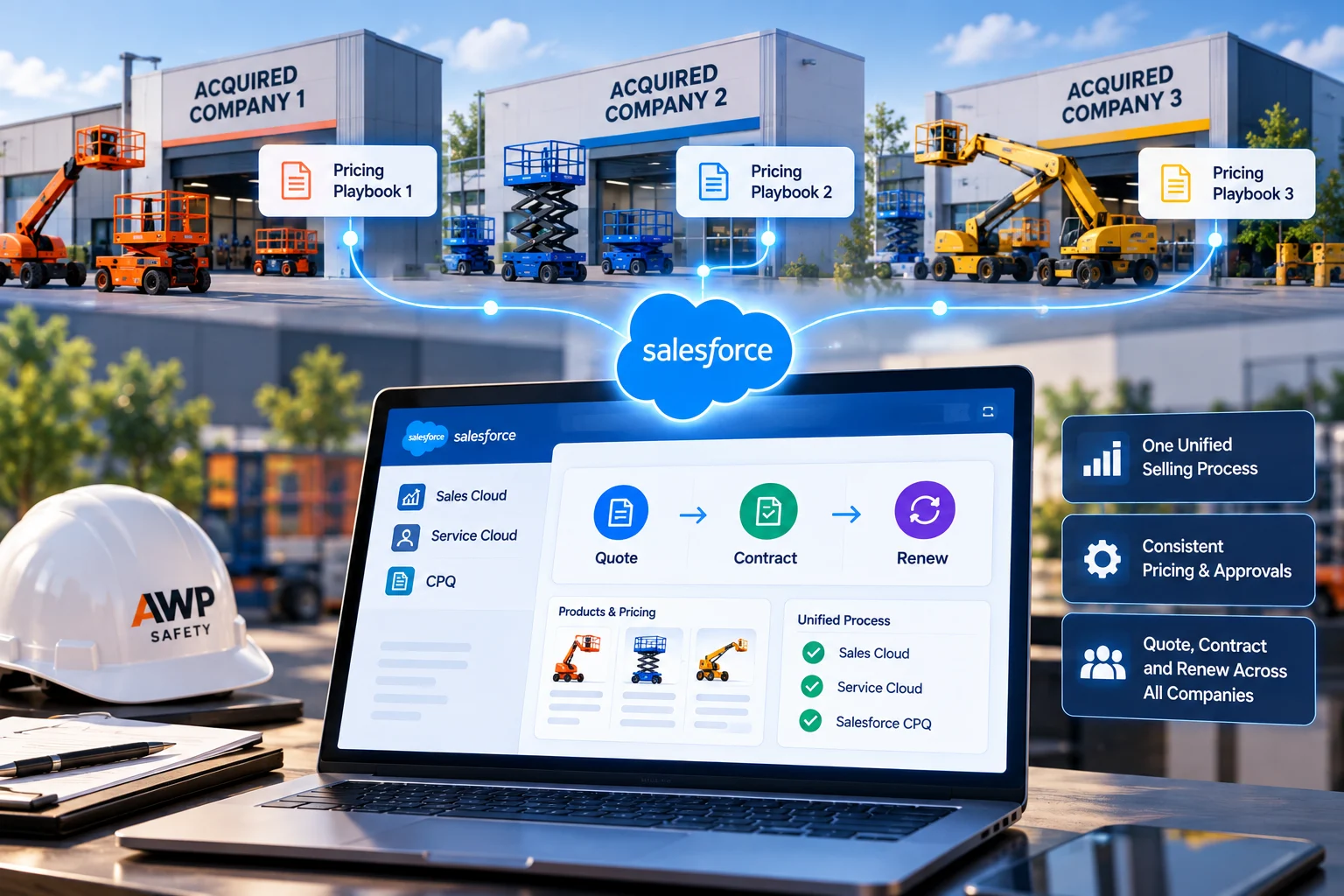
Growth through three acquisitions brought three pricing models and three ways of selling.
What we did
Built one Salesforce selling process across all three companies, with guided selling and automated renewals.
Result
Three companies now quote, renew and cross-sell as one business.
Clients rate Stack Intelligence 5/5 on Salesforce AppExchange, and these four quotes came in after their projects wrapped.
Showing testimonial 1 of 4: Vince Tan, Director of IT, Ascensus Specialties
At Stack, a manufacturing Salesforce implementation moves through seven steps. Step one follows a quote all the way to an order, and step seven is support after launch. Your team signs off at each step.
We pick one real order and walk it from quote to shipment to service call, talking to every team it passes through.
Already on Salesforce? We comb through the org, its integrations, and the pricing logic that's been parked in spreadsheets.
We give products, accounts, assets, and agreements a proper home in the data model, and agree on which system holds the master copy of each.
Everything gets built in a sandbox over short sprints. We reach for configuration before code, and you get a live demo when each sprint wraps.
ERP, MES, and finance links get switched on in the test environment while we clean up and trial-load product, pricing, and customer data.
Your real quote, order, and warranty scenarios get run start to finish. After that, your own people take it for a spin in user acceptance testing.
Go-live comes first, then training for reps, service staff, and admins, then hypercare. We stick around after that, too.
Less Pitch, More Partnership
We spend the early weeks learning your business before we open Salesforce. How does a product get configured? How do dealers place orders? Who signs off on a warranty claim? Getting those answers right is a big reason manufacturers keep working with us.
Hire Salesforce ConsultantsAWP Safety, Zonar Systems, and NITOR all sell physical products with real configuration and pricing rules. We've built Salesforce around those rules before.
The data model follows your products, accounts, and channels. Configuration starts once your team agrees with the design.
Salesforce CPQ, Agentforce Revenue Management, and CPQ migrations make up a big share of our work. Every pricing rule gets written down and checked before the build starts.
We plug Salesforce into ERP, MES, and finance, and keep the data clean so Agentforce has something useful to work with later.
Architects, developers, admins, and analysts work on one team. The certified people are the ones on your project.
Price lists, products, and plants keep changing after launch. Our Salesforce managed services for manufacturing keep the org in step, and Zonar Systems moved straight into them after go-live.
Salesforce for manufacturing is usually a mix of Sales Cloud, Service Cloud, and CPQ, configured around how you quote, sell, ship, and support what you make. Salesforce also sells an industry edition called Agentforce Manufacturing (formerly Manufacturing Cloud). It comes with sales agreements, account-based forecasting, and warranty lifecycle management.
Sales, service, and operations stop working from separate records and start sharing one. Reps get quotes out sooner, techs can pull up a machine's warranty and repair history, and leadership's forecast reflects actual orders. For AWP Safety, Stack used it to put three acquired companies on one way of quoting and renewing.
Salesforce CRM for manufacturing is Salesforce tuned for long B2B deals, parent-and-child accounts, distributor networks, and support after the sale. Sales Cloud and Service Cloud form the base, and plenty of manufacturers add CPQ or Agentforce Manufacturing later.
Salesforce CPQ for manufacturing keeps unbuildable configurations off your quotes. It also handles customer-specific pricing, steers reps toward valid options, and routes big discounts to an approver. New quote-to-cash investment from Salesforce now goes into Agentforce Revenue Management (formerly known as Revenue Cloud), and Stack migrates CPQ customers onto it.
Yes. SAP, Oracle, NetSuite, Dynamics 365 Business Central, and most MES platforms can all talk to Salesforce through its APIs, Platform Events, or MuleSoft. We've done it for real: Zonar Systems' orders land in Business Central, and NITOR's sync with QuickBooks.
Yes. Service Cloud logs every case, asset, and repair. Agentforce Manufacturing layers warranty lifecycle management on top, covering programs, claims, and coverage. When a tech opens a case, the machine's whole story is right there.
Agentforce for manufacturing is Salesforce's set of AI agents for manufacturing work. Out of the box, Salesforce includes agent templates for sales planning, warranty claims, and channel management, and agents can draft quotes and service work orders. We usually begin with one or two use cases your data can handle today.
The cost of Salesforce for manufacturing comes in two pieces: licenses and implementation. Licenses vary by product and edition, whether that's Sales Cloud, Service Cloud, or Agentforce Manufacturing, and Salesforce lists its prices publicly. Implementation depends on scope, integrations, and data migration, and we price it once discovery is done.
Most manufacturing Salesforce implementations take a few months. Zonar Systems' Agentforce Revenue Management build took about 20 weeks. Smaller Sales Cloud or Service Cloud projects can wrap up sooner. Multi-cloud builds with ERP integration take longer.
Yes. Stack's Salesforce managed services for manufacturing cover admin, development, and enhancements as your price lists, product lines, and plants change. Zonar Systems moved into managed services right after go-live.
You won't spend the first call explaining what a dealer price list is. Our consultants have worked with warranties and ERP handoffs before, so we get to your setup fast.