





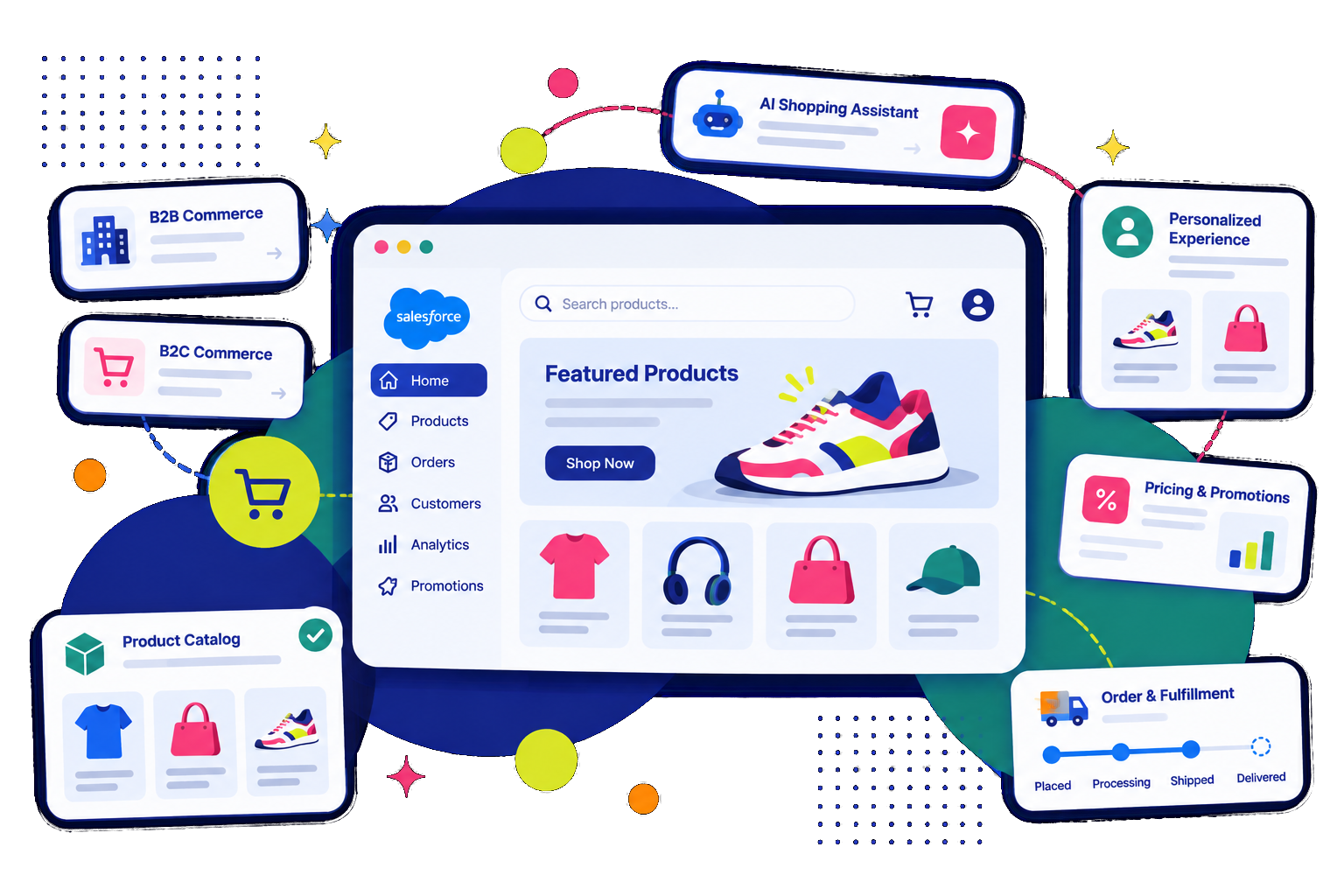
Salesforce Commerce Cloud Consulting & Implementation

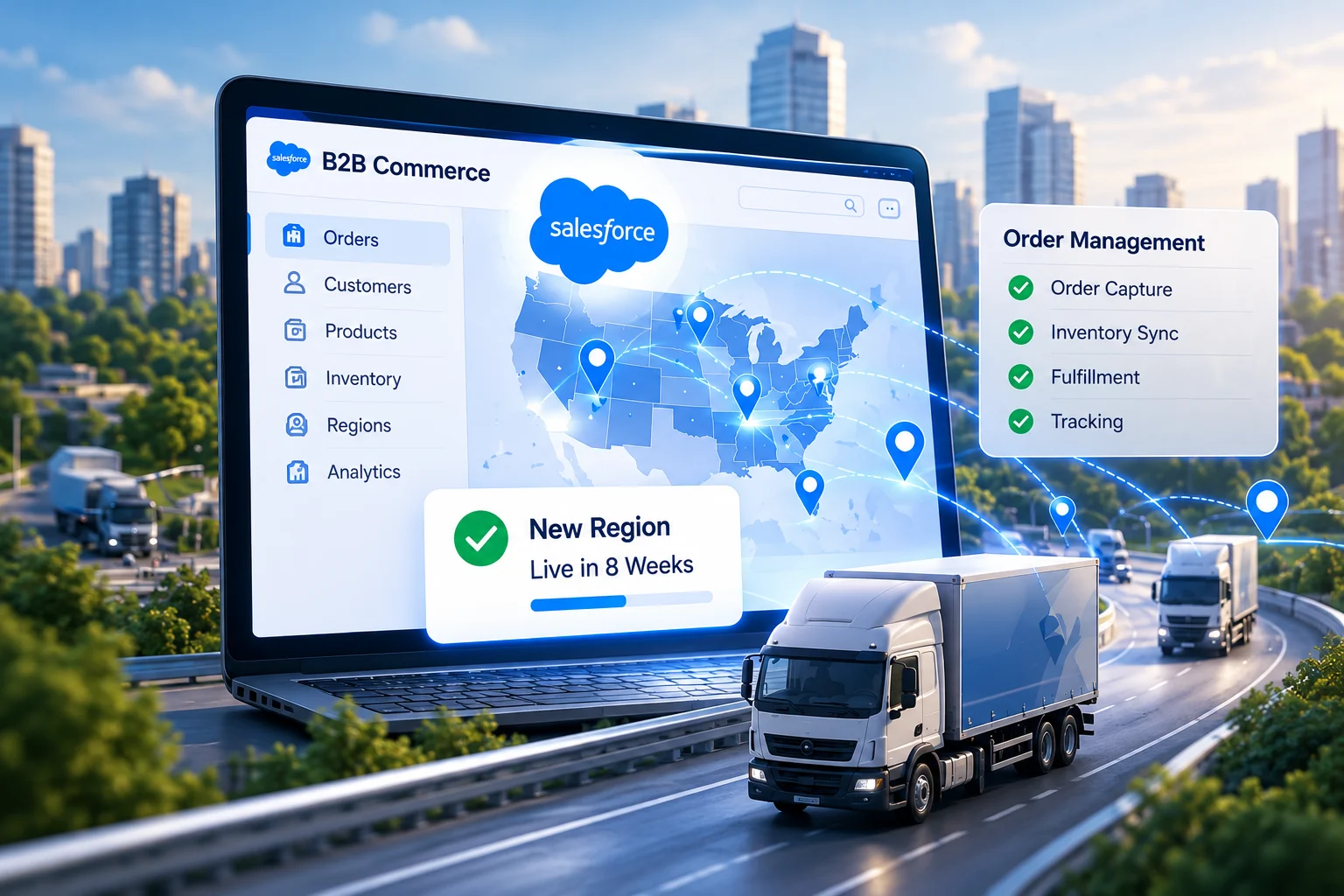
We set up Salesforce Commerce Cloud around how you actually sell, to shoppers or to business buyers. First, we learn your catalog and pricing. Then we build a store that fits and plugs into the systems behind it.

Years in Business
7+
Certified Consultants
50+
Projects Delivered
550+
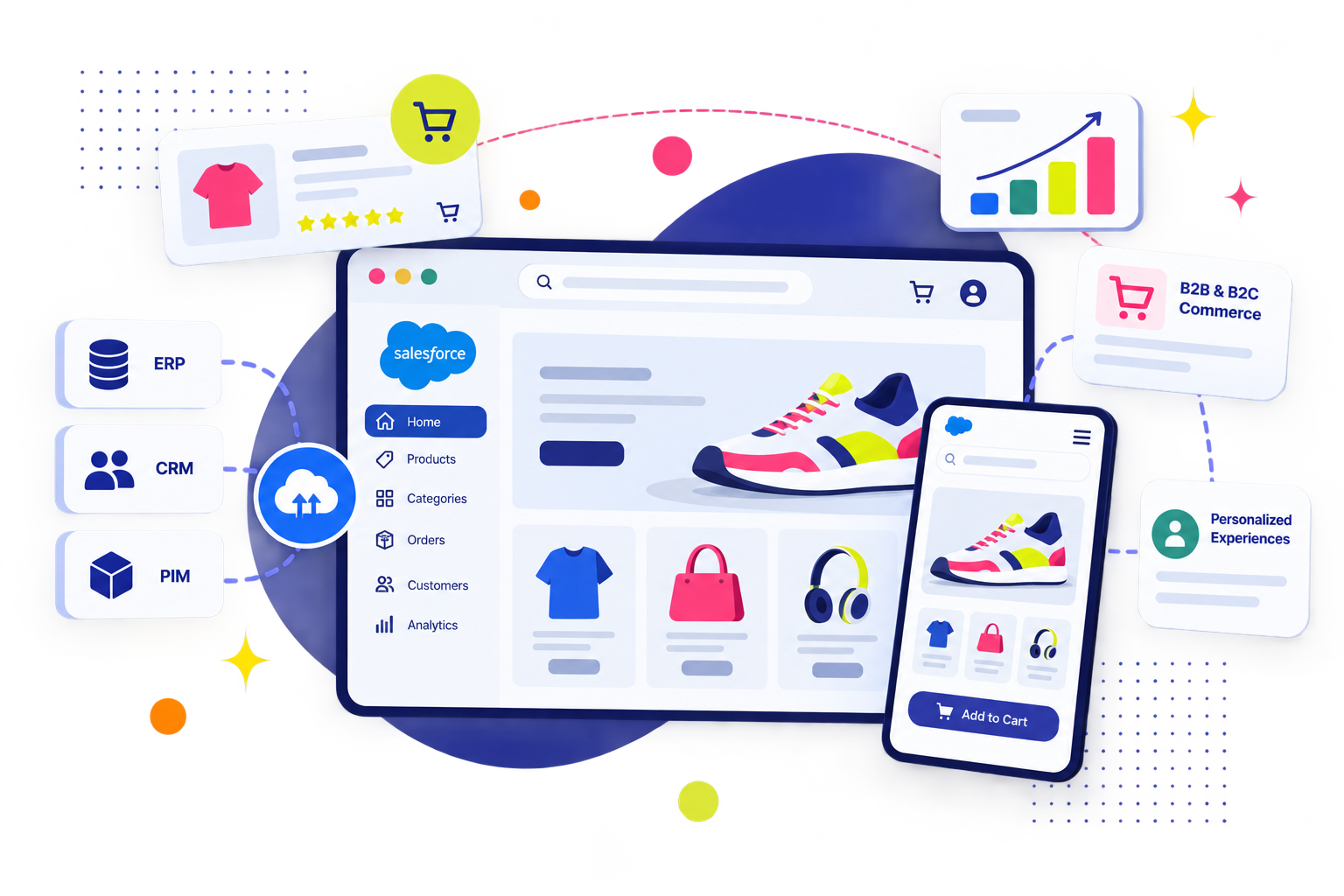
Salesforce Commerce Cloud storefront on desktop and mobile, connected to ERP, CRM and PIM

Trusted by Enterprise Teams as a Salesforce Consulting Partner

Logos of Texas Instruments, American Express, Fiserv, Autodesk, Target, Honeywell, Dell and Delta Air Lines have worked with Stack Intelligence on Salesforce.

Salesforce Commerce Cloud Challenges We Help Businesses Solve

Most commerce teams we talk to have a store that works. It just doesn't keep up anymore. Here's what we hear most.

  • Your Online Store Cannot Keep Up With Business Growth

    The store was fine with 500 products. Now there are 5,000, plus a second region on the way. Pages slow down during sales. Each new feature needs a workaround. Your team ends up fixing the store more than selling from it.

  • Customers Face Friction During Product Discovery and Checkout

    Someone types a part number into search. Zero results. Another adds three items, hits a confusing shipping step, and leaves. You lose sales this way and rarely hear about it. Shoppers don't file tickets for that.

  • B2B Buyers Need More Than a Standard Online Store

    Your business buyers want their own prices and catalog. They reorder the same 40 items every month and need a manager to approve big orders. A consumer-style checkout can't handle that, so they email your sales rep instead.

  • Product, Pricing and Customer Data Are Spread Across Systems

    Product details sit in one tool. Prices come from the ERP. Customer records? Those are in the CRM. Someone copies between them by hand. When a price changes, the website is often the last place to find out about it.

  • Order and Inventory Information Is Difficult to Coordinate

    The site says an item is in stock. The warehouse disagrees. Then customers start calling about their orders. Your team checks two systems just to give an answer. It's a rough call for everyone.

  • Managing Multiple Markets and Storefronts Takes Too Much Effort

    Selling in Canada and the UK as well as the US? You're juggling separate catalogs and currencies. If every storefront is handled on its own, one price change can take all week.

Salesforce Commerce Cloud Features That Support Better Digital Buying Experiences

Talk to a Consultant

You may hear Salesforce call this Agentforce Commerce now, since Salesforce Commerce Cloud sits inside that suite. Most teams lean on the Salesforce Commerce Cloud features listed here. Which ones you get depends on the products you license.

Salesforce Commerce Cloud features: product catalog, B2B and B2C commerce, pricing and promotions, order fulfillment and AI shopping assistant
  1. B2B and B2C Commerce Experiences

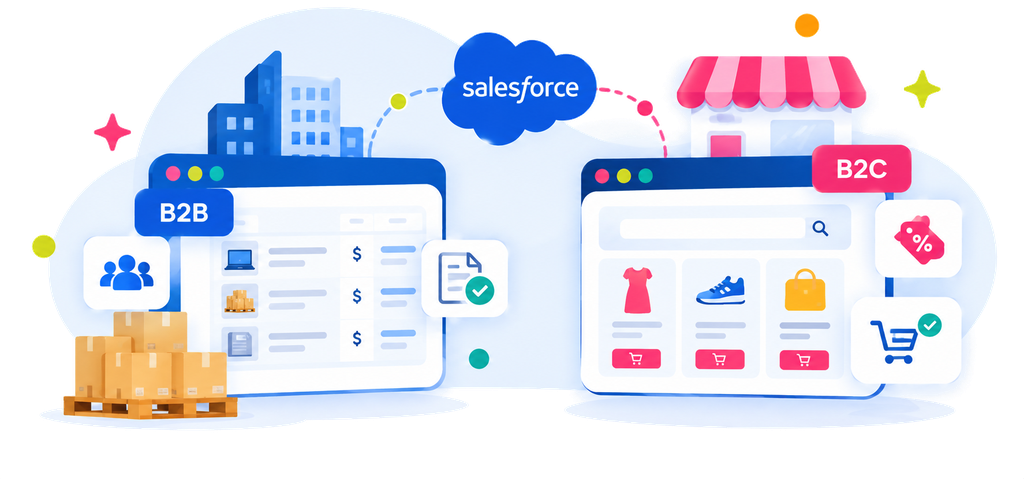
    Business buyers sign in and see a catalog with their own prices. Their orders are usually large, and they come back for the same items. Consumers want to browse a bit and pay fast. With the right licenses, one Salesforce setup handles both.
  2. Product Catalog and Product Information Management

    Products sit in categories with attributes like size or voltage. Some products can be hidden from certain buyers. Got a PIM (a product information tool)? Connect it, and nobody has to retype specs into the store.

  3. Personalized Shopping and Customer Experiences

    A returning shopper might see items related to what they looked at or ordered last time. Business accounts can get their own content on the home page. Better customer data means better results here.

  4. Search, Product Discovery and Merchandising

    Most people start with the search bar. Others filter or browse categories. Your merchandisers decide what shows up first, like a best seller or a holiday item. If a product is hard to find, it usually doesn't sell.

  5. Pricing, Promotions and Discounts

    Set price books for different customer groups. A distributor might see contract prices, while a consumer sees this week's sale. Promotion and coupon rules run on their own once they're set, so nobody edits prices by hand.

  6. Shopping Cart and Checkout

    Shipping choices get picked at checkout, along with tax and payment. Business buyers can check out with a purchase order. Which payment and tax providers you use is up to you. Some of them need their own connector.

  7. Order Management and Fulfillment Visibility

    Paid orders can be sent on to your ERP or order management tool. Shoppers then get real status updates. We map out what your Salesforce products cover before promising anything.

  8. AI-Assisted Shopping and Commerce Operations

    Agentforce Commerce gives shoppers an AI assistant they can ask for help. On your side, merchandisers can have it write first drafts of product descriptions. Your licenses decide what's switched on, and we check that early.

Salesforce Commerce Cloud Services Tailored to Your Business

Our Salesforce Commerce Cloud services cover the whole project, from planning to life after launch. Need just one piece? That works, too.

  • 01 · Consulting

    Salesforce Commerce Cloud Consulting

    Our Salesforce Commerce Cloud consulting services start with how you sell today. Next, we check your current store against what your buyers need. You leave with a roadmap and a clear place to start.

    Consulting Services
  • 02 · Implementation

    Salesforce Commerce Cloud Implementation and Customization

    Our Salesforce Commerce Cloud implementation gets your storefront and catalog live, with pricing and checkout set up. Want something standard features can't handle? We tell you upfront when custom work comes in.

    Implementation services
  • 03 · Integration

    Salesforce Commerce Cloud Integration

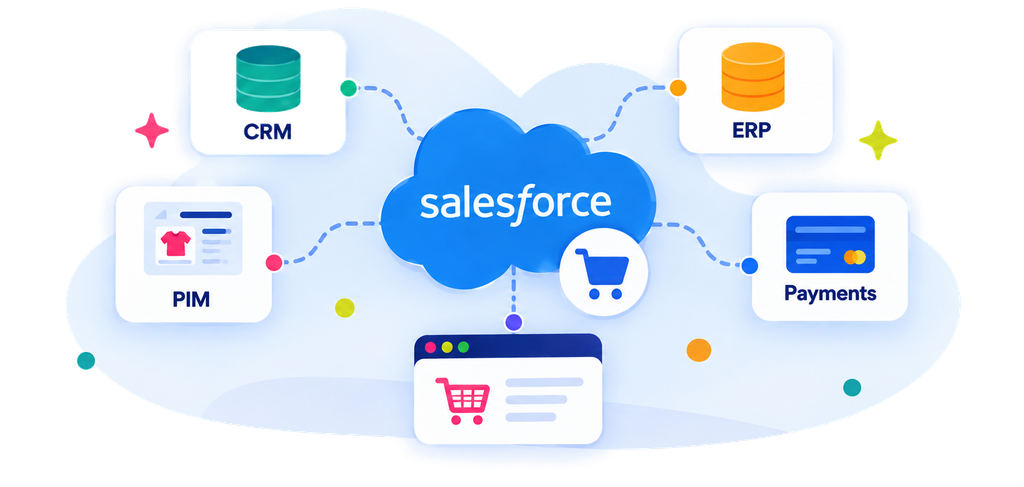
    With Salesforce Commerce Cloud integration, the store gets data from your CRM and ERP. PIM and payment tools connect, too. We map each field and test what happens when a sync fails.

    Integration services
  • 04 · Migration

    Salesforce Commerce Cloud Migration

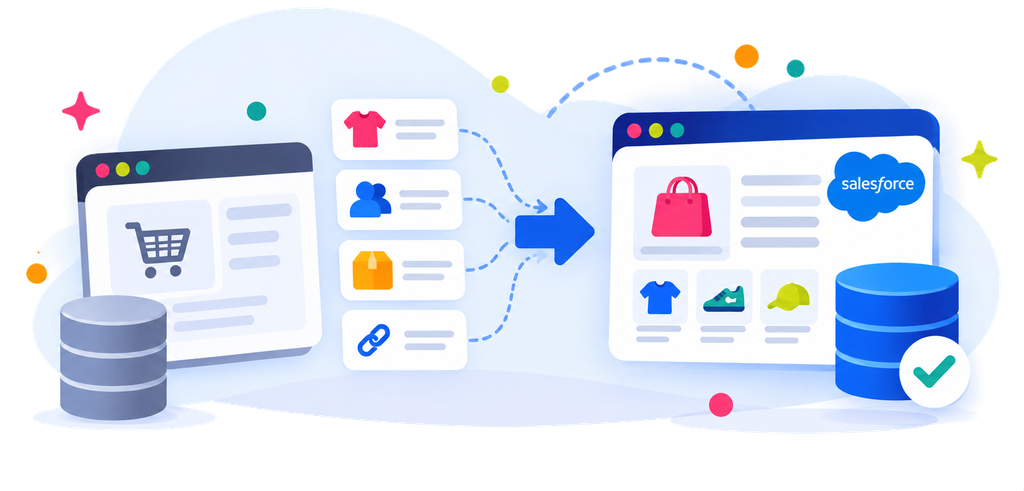
    Leaving another platform? We move products and customers over, along with order history. Old URLs get redirected so you keep your search rankings. Some features will need rebuilding, and we flag those early.

  • 05 · B2B and B2C

    B2B and B2C Commerce Solutions

    Selling to businesses? Buyers get their own pricing and can order in bulk, with approvals when needed. Selling to consumers? They get quick search and an easy checkout, plus deals. We build whichever your business needs, or both.
  • 06 · Managed services

    Commerce Optimization and Managed Services

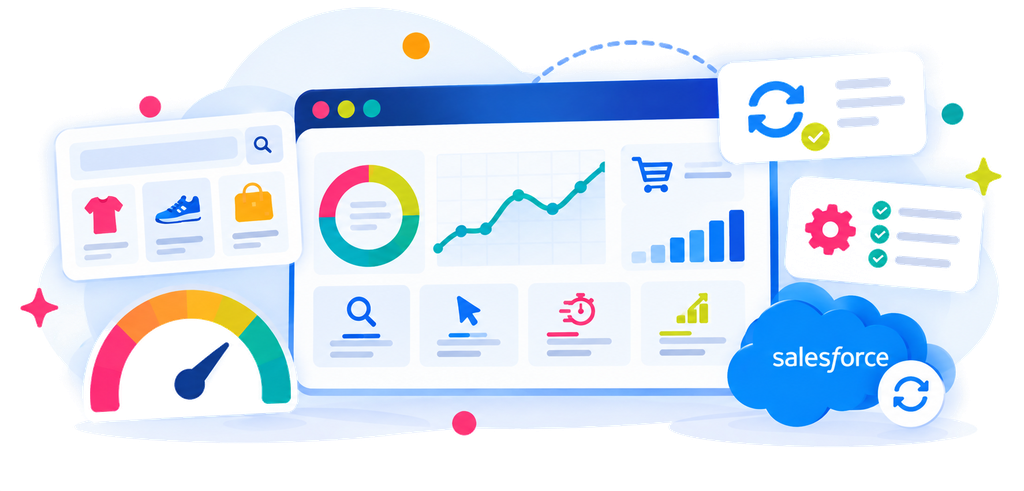
    Once you're live, we watch how buyers move through search and navigation. Anything slowing them down gets fixed. Our managed services team also takes care of enhancements and each Salesforce release.

    Managed services

Ready to Build a Better Commerce Experience?

What's getting in your buyers' way right now? Show us the store. We'll tell you what to fix first.

Salesforce Case Studies From the Field

Pick a cloud and see what we built, for whom, and what changed after go-live.

View All

Stack Intelligence Client Testimonials

Clients rate Stack Intelligence 5/5 on Salesforce AppExchange, and these four quotes came in after their projects wrapped.

Industries We Serve With Salesforce

Pricing and service work differently in each industry, so we design Salesforce around yours.

Advanced manufacturing plant

Manufacturing

Configurable products, dealer pricing, quoting and field service in one Salesforce org.

Read More
Enterprise data center

High Tech & Software

Subscription billing, partner programs and integrations that keep up as you grow.

Read More
Financial district architecture

Financial & Professional Services

We set up Salesforce so your team sees the whole story on one record.

Read More
Medical research laboratory

Healthcare & Life Sciences

Patient and customer portals, ordering and service workflows with secure data.

Read More
Online shopping cart with parcels

Retail & Consumer Services

When we're done, your staff can pull up any order, booking, or chat from one customer record.

Read More
Truck fleet at a depot

Automotive & Transportation

Stack Intelligence sets up Salesforce Automotive Cloud so carmakers, dealers, and fleets share one view.

Read More
Classroom desk with books and pencils

Education

Your institution probably runs on a dozen systems that rarely talk to each other.

Read More
Two construction workers in hard hats at a building site

Construction & Real Estate

If you sell homes, lease offices, or build them, you're tracking a lot of people at the same time.

Read More
Public civic building

Public Sector

Experience Cloud portals and oversight workflows, plus ServiceNow work for federal and utility clients.

Read More

Looking for a Salesforce Commerce Cloud Implementation Partner?

Show us how you sell and the systems you already run. We'll sketch how a Salesforce Commerce Cloud build could fit around them.

Connect Salesforce Commerce Cloud With Your Business Systems

Salesforce Commerce Cloud integration is where most commerce projects get tricky. Your store needs data from many places. We connect these most often. Your systems and licenses shape how we do it.

  • Connect your store with Salesforce CRM, and sales and service can see what each customer bought. A rep can check an order before a call. A service agent can pull up purchase history while working a case.

  • Prices and stock usually come from the ERP. Order status does, too. We connect it so the store shows current numbers. The build depends on which ERP you run and how often data should refresh.
  • Your PIM holds product names and specs, plus images. Once it's linked, one edit updates every storefront. Your team edits a product one time and stops copying details between tools.
  • Payment, tax, and shipping providers all connect separately. For some, a connector already exists. Others need custom work. We check which is which during planning.

  • Your marketing tools, Marketing Cloud included, can use commerce data. Left a cart behind? A reminder email can go out. Monthly buyers might get a nudge to reorder. Consent settings control what's shared.

  • Everything else connects through APIs, or through MuleSoft if you use it. Your systems and data volume decide which route we take. Some data can update every few hours, and that's fine. We agree on timing with you early.

Our Salesforce Commerce Cloud Implementation Process

Get a tailored build plan

Every Salesforce Commerce Cloud implementation we run follows six steps. We set dates once we know your scope.

  1. Discovery and Business Requirements

    We begin by asking about your buyers and how they place orders. Then we go through pricing rules and your catalog. We also look at the systems behind today's store. You sign off on a short summary before design begins.

  2. Solution Design and Architecture

    Then we sketch the storefront and integration plan together with your team. Data needs and scope go in writing. We don't build until you've approved it.

  3. Commerce Configuration and Storefront Development

    The catalog and pricing go in first. Buying flows follow. Custom pieces come after that. We show you demos as pieces come together. Early changes are cheaper, so speak up.

  4. Integration and Data Preparation

    Now your ERP and CRM get connected, along with anything else on the list. We clean product and customer data before it moves, and pricing data, too. Record counts get checked with you, so nothing important is lost.

  5. Testing and Business Validation

    Real buying scenarios get run through search and pricing, then cart and checkout. Integrations and user access get checked, too. Then we put the store under heavy traffic to see how it holds up before a single customer sees it.

  6. Launch and Continuous Optimization

    Launch follows the plan we agreed on. For the first few weeks, we keep a close eye on key workflows. After that, we look at real buyer data with you. Then we pick the next improvements with you.

Why Choose Stack Intelligence for Salesforce Commerce Cloud Consulting?

A store should still fit your business a year after launch. Here's how our team works toward that.

Hire Salesforce Consultants
  1. 01. We Learn How You Sell First

    Before touching Commerce Cloud, we learn how your customers buy. Do they reorder monthly? Need approvals? Pay on terms? Those answers shape the catalog, the pricing rules, and how checkout works for each buyer.

    02. Commerce Tied Into the Rest of Salesforce

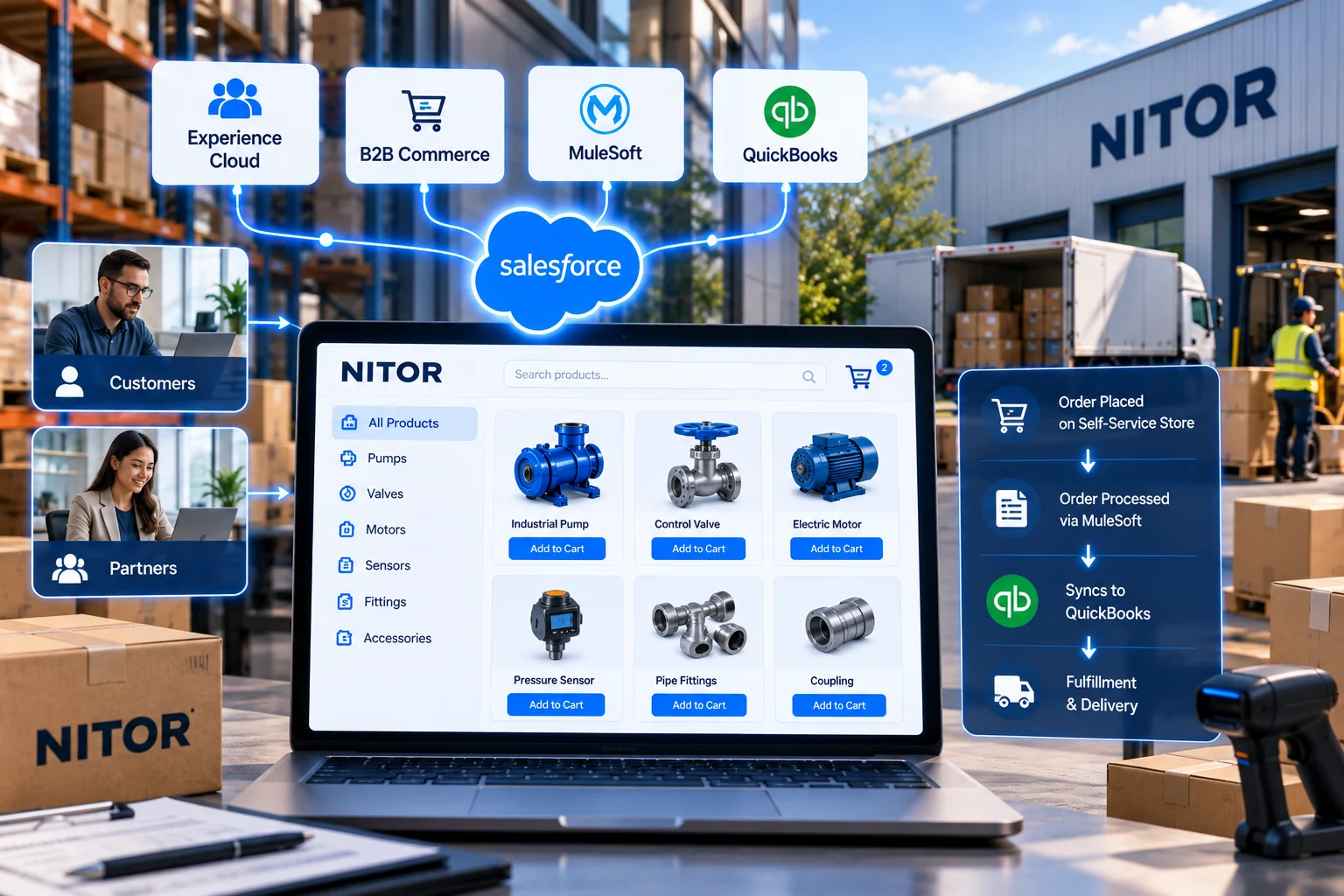
    We've delivered a B2B Commerce and Experience Cloud project tied to QuickBooks through MuleSoft. Our team also builds on Sales Cloud and Service Cloud. So your store can share data with the rest of your business.

  2. 03. Clean Builds for Tricky Catalogs

    A catalog with thousands of items and special pricing can turn into a mess. We keep things simple wherever we can. If we build something custom, we write down why, and what else relies on it.

    04. A Store Your Team Can Run

    We write down how everything is set up. Your team learns to update products and prices themselves, promotions, too. New hires can get up to speed without calling us.

  3. 05. Steady Help Once You're Live

    Once the store is live, our managed services team takes on fixes and new requests. Salesforce ships three releases a year, and we test each one against your store. You choose how much help you want from us.

Frequently Asked Questions About Salesforce Commerce Cloud

Salesforce Commerce Cloud is what Salesforce offers for running an online store. You can sell to shoppers with it, or to other companies. You may also see it called Agentforce Commerce, the newer name for the suite. Your catalog and prices run on it, along with search and checkout. Because it ties into Salesforce CRM, your reps can look up past orders.

The storefront and catalog come first for most teams. Site search is right up there, too. Personalization and promotions come with it, and so do cart and checkout. Selling to businesses? You also get account pricing and bulk ordering, and buyers can reorder in a couple of clicks. Salesforce Commerce Cloud features differ between licenses. Look at yours before you plan.

Most Salesforce Commerce Cloud services start with a consulting phase. Implementation follows. Expect a bit of custom work on almost any project, and an ERP or CRM connection on most. Coming from another platform? Migration gets added. After go-live, we keep improving the store and fixing what comes up. Pick one of these services, or hand us the lot.

First comes discovery. We learn how you sell and what's in your catalog. With that in hand, we design the store and configure it. Integrations come after, and we run test orders through them. Your team gets trained before launch. Big rollouts usually go one region or brand at a time. That's a common way to run a Salesforce Commerce Cloud implementation.

You can't easily take back certain choices once the store is live. Catalog structure is one. Pricing setup is another. When you hire a Salesforce Commerce Cloud consultant, you get someone who's made those calls before. Integration issues get caught early, too, before they cost real money.

See if they've built stores for companies like yours. Then ask about your ERP. Would they use an API, or MuleSoft? And what's the plan for moving your old data? In our experience, a Salesforce Commerce Cloud implementation partner who can answer that in a sentence or two usually knows the work. Testing matters, so ask how they do it. Then there's support after launch. We'd suggest talking to two or three Salesforce Commerce Cloud partners before you pick one.

On the B2B side, you're selling to other businesses. They log in to an account and see contract prices. Big orders often need a manager's approval. B2C commerce serves everyday shoppers who want quick search and a fast checkout, plus the odd deal. Plenty of companies run both on Salesforce. Not sure which you've got? Your license paperwork will say.

Yes. Very few ERPs or CRMs can't talk to Salesforce Commerce Cloud. Smaller jobs run on APIs. Bigger ones often go through MuleSoft. Customer records and product data can sync. So can prices and orders. Some teams sync every hour. Others are fine with once a night.

For the most part, yes. We'll go line by line through your catalog and pricing rules with your team while we design. Standard features cover most of them. A few unusual pricing setups might need custom work. Your data model and licensed products shape the final approach.

Yes. Your US shoppers see dollars. UK shoppers see pounds (and "colour" spelled their way). Each market can also get its own catalog and prices. Some things can be shared across stores. Your products and our agreed scope decide how much.

That comes down to scope. One storefront with a modest catalog is a much shorter project than a launch across several regions with a handful of integrations. Catalog size matters. So do custom features and how clean your data is. After discovery, you'll get dates we can stand behind.

Yes, most of the time. Product and customer data tend to come across fine. Order history often can as well. We set up redirects from old URLs so your search traffic stays. Anything custom on your old store may have to be rebuilt. Your current platform and data quality decide the effort.

After launch, Stack Intelligence stays on through support and managed services. We fix issues and handle new requests. When Salesforce ships a release, we test it against your store. You can book a fixed number of hours each month, or just call us when something new comes up. We plan the scope around what your own team covers.

Yes, through Agentforce Commerce. A shopper types what they need, and an AI assistant points them to the right products. Your merchandisers can ask it for a first draft of a product description. Features vary by license. We confirm what you have before building around it.

Ready to Build a Better Commerce Experience With Salesforce?

Got a list of things your store should do better? Send it over, along with the tools you use today. We'll sketch a Salesforce Commerce Cloud implementation around it.