What is Salesforce consulting?
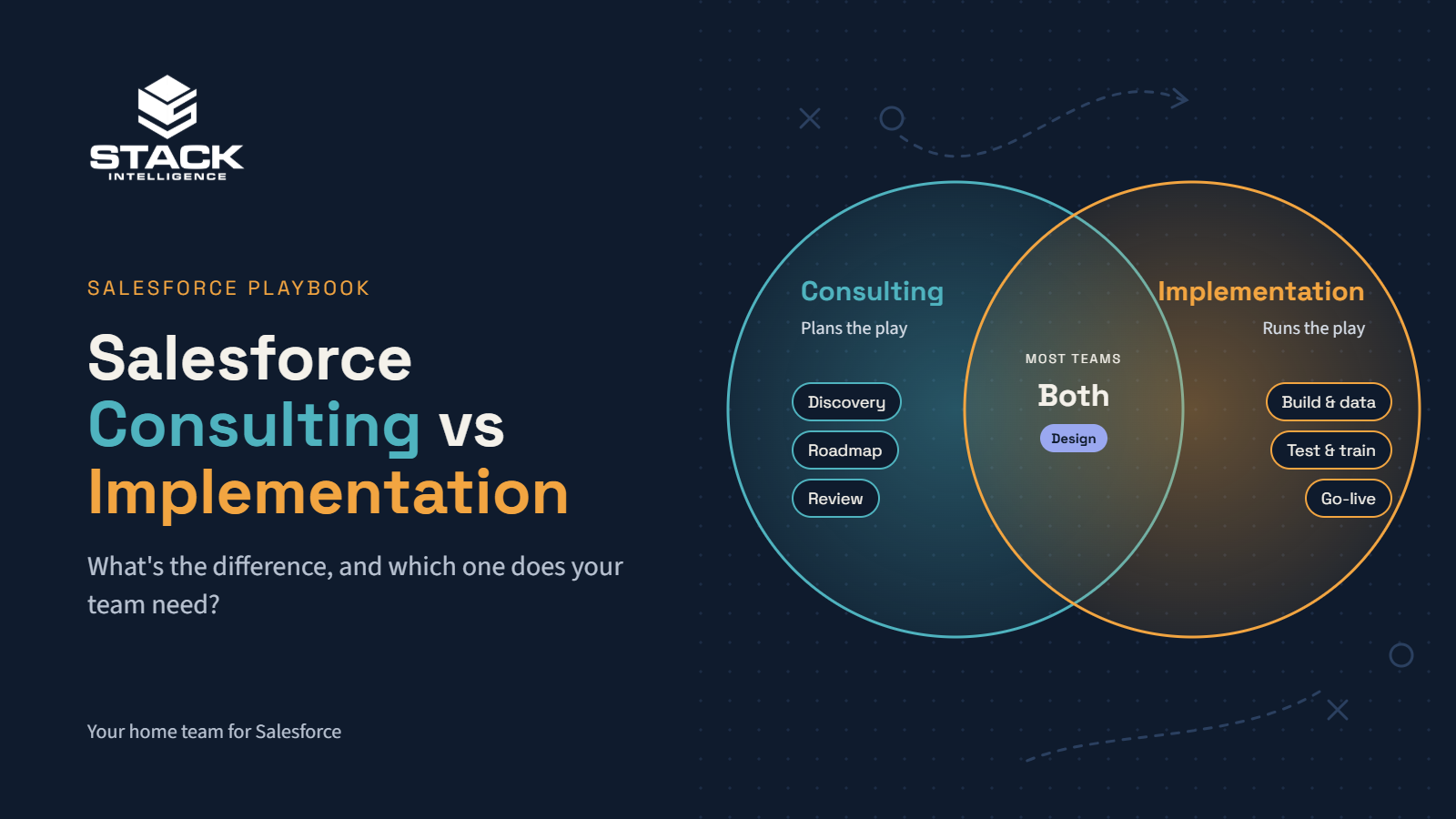
Salesforce consulting is the advice and planning work around Salesforce. A consultant looks at your goals, your day-to-day processes, and whatever you’ve already set up. You get back a roadmap. It says what to build, what comes first, and why. Call it the pre-season film session.
The big question here: what’s worth building, and why?
Here’s what’s usually on the table:
- Discovery. Talks with the people in sales, service, ops, and leadership.
- Process mapping. Where work gets stuck today.
- A roadmap. What to build first, and what can wait.
- Product advice. Which Clouds and add-ons you really need.
- Org health checks. For teams already on Salesforce that feel stuck.
What you walk away with is a document. A roadmap, a requirements list, a business case. Translation: a plan, not a working system.
Consulting is also where you get talked out of things. A good consultant will tell you which features you don’t need yet. That alone can save a chunk of budget.
What is Salesforce implementation?
Salesforce implementation is the hands-on work of building, testing, and launching Salesforce for a business. A delivery team turns the plan into a working org. They configure it, connect it, load your data, and train your people. This is game day.
The question it answers: Who builds it, and how do we go live?
An implementation project usually covers:
- Configuration. Objects, fields, page layouts, Flows, and permissions.
- Custom development. Apex or Lightning components, only when needed.
- Integrations. Connecting Salesforce to your ERP, billing, or marketing tools.
- Data migration. Cleaning old records and moving them in.
- Testing. Real users try it before launch.
- Training and go-live. Then support while people settle in.
What you walk away with is a live system. Your team logs in on Monday and does real work in it.
Implementation also carries the delivery risk. If the timeline slips or the data is wrong, that’s on the build team. A consultant who only advises doesn’t own that risk.
Salesforce consulting vs implementation: side by side
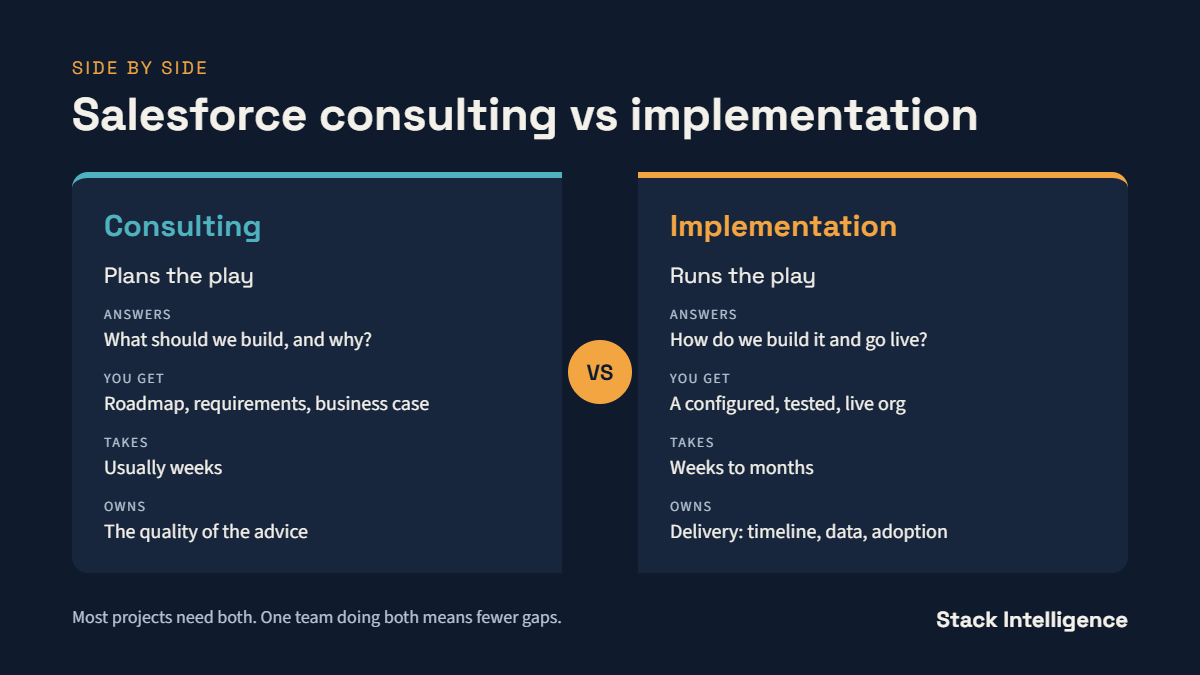
Here’s the quick version.
| Salesforce consulting | Salesforce implementation | |
|---|---|---|
| Main question | What should we build, and why? | How do we build it and go live? |
| Main output | Roadmap, requirements, business case | A configured, tested, live org |
| Typical work | Discovery, process mapping, product advice | Setup, integrations, data migration, training |
| Custom code | Rarely | When configuration can’t do the job |
| Team | One consultant or a small group | Architect, consultants, developers, PM |
| Length | Usually weeks | Weeks to months |
| Risk owned | Advice quality | Delivery: timeline, data, adoption |
| Best fit | Unclear goals, stuck orgs, big decisions | Clear goals, new rollouts, migrations |
In short, consulting shapes the decision. Implementation delivers on it.
When do you need Salesforce consulting?
If you can’t yet say what you want, start with consulting. Some common signs:
- You’re new to Salesforce and don’t know which Clouds you need.
- Leaders disagree on goals, or nobody has written them down.
- You’ve had Salesforce a while and people still avoid it.
- Your org is cluttered with old fields, half-broken automations, and reports nobody trusts.
- You’re weighing a big move, like adding Marketing Cloud or Agentforce.
When do you need Salesforce implementation?
If the plan is already settled, skip ahead to implementation. That usually looks like this:
- Your requirements are written and signed off.
- You’re leaving an old CRM, or a pile of spreadsheets, behind.
- Salesforce needs to talk to your ERP, billing, or online store.
- There’s a fixed launch date, and you need people building now.
Do you need both?
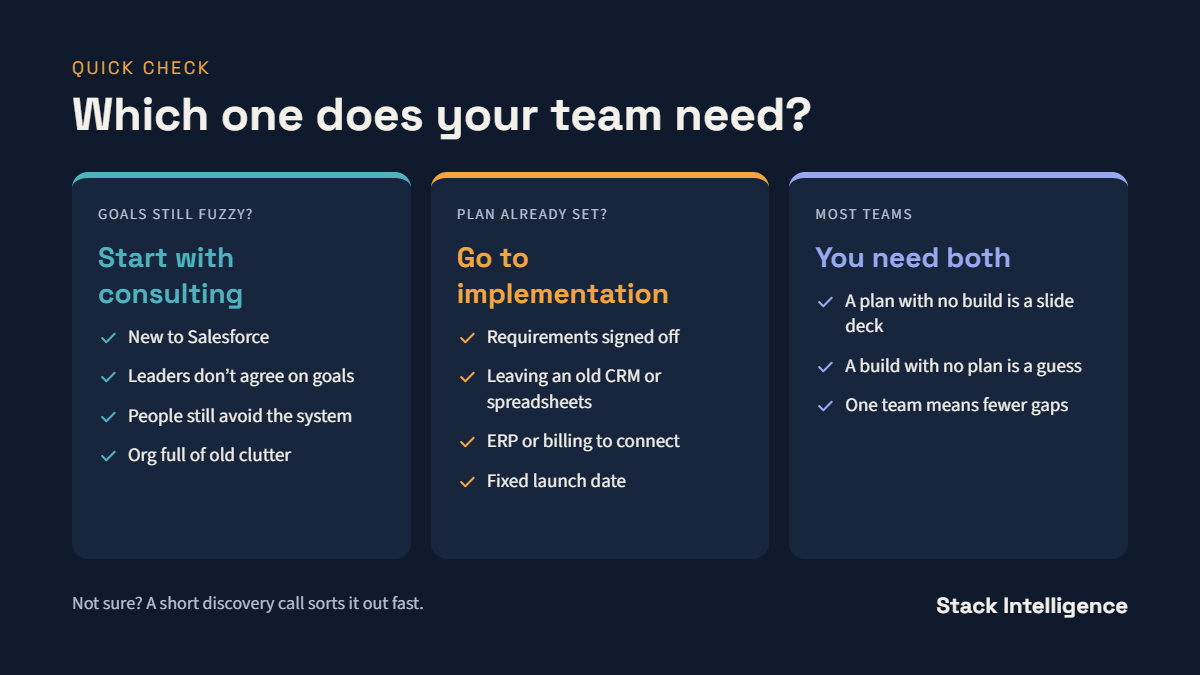
Most of the time, yes. A plan with no build is just a slide deck. A build with no plan is a guess.
Plenty of companies bring in outside help here. In fact, Salesforce says 90% of its customers lean on partner apps and experts. It also tells customers to bring a partner in early, because teams that join late often miss part of the scope.
So do you hire one firm or two? With one, there’s no handoff to manage. Whoever did the planning sticks around to build, so details don’t get dropped. Two firms can work too. Just get the build team in the room before the plan is locked.
How do Salesforce consulting and implementation work together?
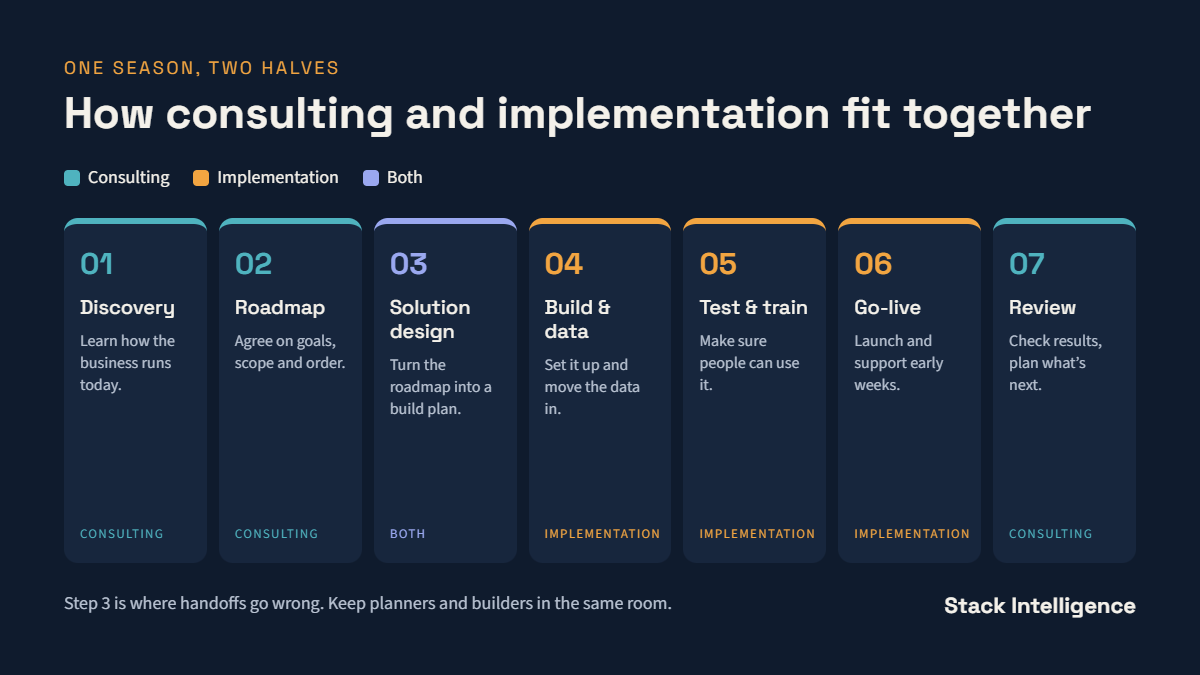
On a healthy project, they’re two halves of one season. Here’s the usual order:
- Discovery (consulting). Learn how the business runs today.
- Roadmap (consulting). Agree on goals, scope, and what comes first.
- Solution design (both). Turn the roadmap into a build plan.
- Build and data migration (implementation). Set it up and move the data.
- Testing and training (implementation). Make sure people can use it.
- Go-live (implementation). Launch and support the first few weeks.
- Review (consulting). Check results and plan the next phase.
Step 3 is where most handoffs go wrong. If the planners and builders aren’t in the same room, details fall through. That’s the strongest case for one team doing both.
Where do managed services fit in?
There’s a third piece some firms add. Managed services kick in after launch. Think admin help, small fixes, and release updates on a monthly plan.
Salesforce ships new features three times a year, in its Spring, Summer, and Winter releases. So even a great build needs ongoing care. If you don’t have a full-time admin, ask about this early.
How do cost and timelines compare?
There’s no standard price for either. It depends on scope. Still, the patterns are pretty steady.
- Consulting is usually shorter. Most engagements run a few weeks. They’re often priced as a flat fee or by the hour.
- Implementation takes longer and costs more. A small single-cloud setup can take a few weeks. Multi-cloud builds with heavy data work often run for months.
- Managed services are ongoing. Most are billed as a monthly retainer.
One tip: be careful with any firm that quotes a full build on the first call. Nobody can price it before they’ve seen your data.
How do you choose the right partner?
Whatever you hire for, ask these questions:
- Do you do consulting, implementation, or both? Who handles the handoff?
- Who exactly will be on our project? Get names and certifications.
- Can you show a case study like ours, with real numbers?
- Do you start with configuration before custom code?
- What happens after go-live? Ask about support and release updates.
For the deeper checklist, see our guide on what a Salesforce implementation partner actually does.
How does Stack handle consulting and implementation?
Stack Intelligence is a Salesforce team based in Beachwood, Ohio. We’re hometown friends who’ve been running plays together since Little League.
We don’t make you pick a side in the Salesforce consulting vs. implementation debate. The same crew plans it and builds it. So the person who heard your goals in discovery is still around on launch day.
Our playbook is short. Find what’s broken. Fix it in plain English. Then check the scoreboard. The scoreboard isn’t hours billed. It’s whether the outcomes showed up.
Grab a 25-minute working session. Bring the part that’s stuck. You’ll leave knowing whether you need consulting, implementation, or nothing at all.
Keep exploring
Still sorting out Salesforce consulting vs. implementation for your team? See how we run both in our Salesforce implementation services.
Just getting started? Our guide on what a Salesforce implementation partner actually does is a good first read.
Not sure which one your org needs? Book a working session, and we’ll give you a straight answer.
We share short Salesforce tips and client wins on social. Follow Stack on LinkedIn to keep up.