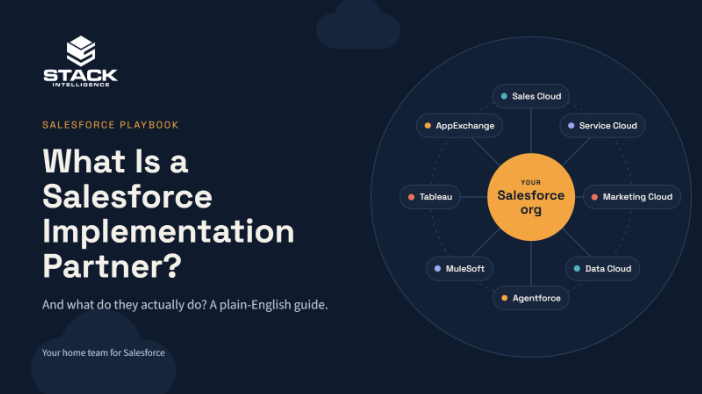
What is a Salesforce implementation partner?
In plain terms, it’s an outside firm Salesforce has reviewed and approved. Its job is to set up Salesforce for customers like you. Some call it a “Salesforce consulting partner.” Others say “SI partner.” For this post, they mean the same thing.
Most partners have a lane. Some stick to Sales Cloud. Some live in Service Cloud. Others work in one industry, like the public sector, healthcare, or nonprofits. When you shortlist, ask one thing first. Have they fixed your exact problem before? A long logo wall looks nice, but it won’t tell you that.
What does a Salesforce implementation partner actually do?
They own the path from “we bought Salesforce” to “people actually use it.” Translation: the settings screens are the smallest part of the job.
The work usually runs in this order. In real life, the steps overlap a bit.
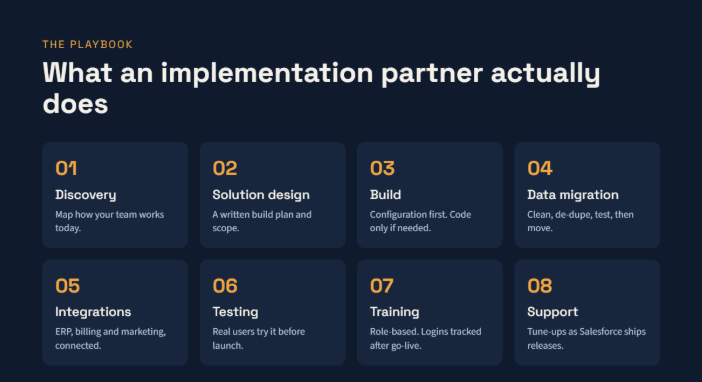
- Discovery. First, the partner learns how your team works today. How do you sell? How do you handle support? Where do reports break? Expect a few calls with Sales, Ops, and IT together.
- Solution design. Next comes a written build plan. It covers objects, fields, automation, and security. It also lists what’s out of scope. Don’t skip that part.
- Configuration and build. Most of the work should use Salesforce’s own tools, like Flows and permission sets. Custom code (Apex, Lightning Web Components) comes in only when configuration can’t do the job.
- Data migration. Your old data gets cleaned and mapped. Duplicates are removed. Then it’s moved in. Timelines slip here more than anywhere, so run test loads early.
- Integrations. Salesforce is hooked up to your ERP, billing, marketing or online store. That way, each customer lives in one record.
- Testing. Your daily users try it before launch. This is called user acceptance testing. Skip it and launch day gets interesting.
- Training and adoption. Each role gets its own training. Help docs stay short. Someone checks logins two weeks after launch.
- Post-launch support. Salesforce ships three big releases a year. Your setup needs tune-ups to keep up. Many partners offer managed services for this.
The last two steps tend to be where a cheap implementation gets found out. A build can be perfect and still sit unused.
Why work with a Salesforce implementation partner?
A good Salesforce implementation partner saves you from learning the hard way. They’ve seen the common mistakes. You don’t have to make them yourself.
Here’s what you usually get:
- A faster go-live, since they’ve run this playbook many times
- Fewer do-overs, because problems get caught during design
- Cleaner data, fixed on the way in
- Better adoption, with training built around how your people work
- Less risk, since security and compliance get planned from day one
Who’s on a partner’s team?
A Salesforce implementation partner brings a full bench. The lineup changes by project. Most teams include these roles:
- Project manager. Keeps scope, budget, and dates on track.
- Solution architect. Designs how everything fits together.
- Consultant. Turns your process into Salesforce setup.
- Developer. Writes custom code when it’s truly needed.
- Admin. Handles daily setup and user requests.
Your side matters too. Name one internal owner. Get an executive sponsor. Pick a few power users to test early and give feedback.
How is a partner different from a consultant or an in-house admin?
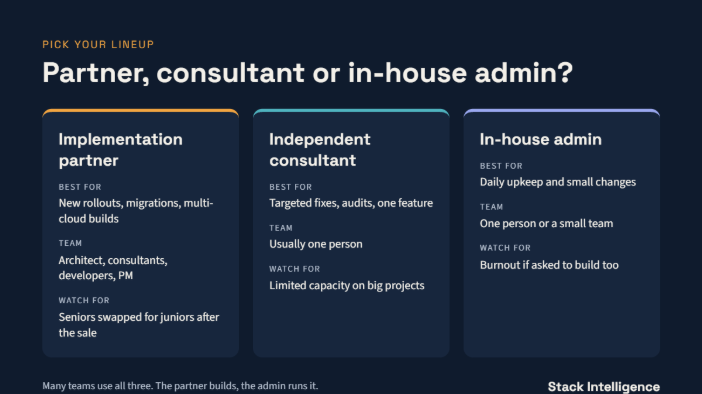
| Implementation partner | Independent consultant | In-house admin | |
|---|---|---|---|
| Best for | New rollouts, migrations, multi-cloud builds | Targeted fixes, audits, one feature | Daily upkeep and small changes |
| Team | Architect, consultants, developers, PM | Usually one person | One person or a small team |
| Scope | End-to-end, discovery through support | Narrow and specific | Ongoing operations |
| Watch for | Senior people swapped for juniors after the sale | Limited capacity on big projects | Burnout if they’re also asked to build |
You don’t have to pick one. Many companies use all three. The partner builds it, and the admin runs it. A specialist steps in when something odd comes up.
Do you need a Salesforce implementation partner?
It depends on your starting point. Say you’re a 10-person team on Sales Cloud. Your data is clean, and your admin is sharp. You can probably do it yourself.
You’ll probably want a partner if:
- You’re moving off another CRM or a stack of spreadsheets
- Salesforce has to talk to an ERP, billing, or e-commerce platform
- More than one department, or more than one Salesforce Cloud, is involved
- You work in a regulated space with real security and compliance needs
- Your last rollout didn’t stick, and adoption is still low
When should you bring a partner in?
Earlier than you think. Salesforce says to bring one in once your goals are clear. Partners who show up late tend to miss scope.
Let the partner help with the “what” first. That means goals, success metrics, and a real timeline. Then build the “how.” Bring them in before the budget is set. You’ll avoid paying for the wrong scope.
What are the ways to work with a partner?
There’s more than one way to work with a Salesforce implementation partner. Pick based on budget and in-house skill.
| Model | How it works | Good fit when |
|---|---|---|
| Full build | The partner does it all | You have no Salesforce team yet |
| Shared build | You split the work | You have an admin who wants to learn |
| Advisory | Your team builds, the partner guides | You have strong in-house skills |
Full builds cost more up front. Shared builds need more coordination. Advisory usually takes the longest.
How do you choose the right Salesforce implementation partner?
Certifications get a partner in the door. What separates partners is how they work after the contract is signed. Ask these on your first few calls:
- Who exactly will be on our project? Get the architect’s name. Get the lead consultant’s too. Put both in the contract.
- Can you show a case study like ours? Ideally, it’s the same industry or the same problem, and it has actual numbers in it.
- How do you decide between configuration and custom code? You want to hear “configuration first.”
- What’s your plan for adoption after go-live? A fuzzy answer is a warning sign.
- What happens after launch? Ask about support hours and response times. Ask how they handle Salesforce releases.
Be careful with a fixed quote on the first call. Nobody can price your project before they’ve seen your data.
You can check partners on the Salesforce AppExchange. It shows their certifications and customer reviews.
What red flags should you watch for?
Not every partner is a good fit. Watch for these:
- They pitch with senior people, then staff the project with juniors.
- Every request turns into custom code.
- There’s no budget for training or change management.
- They can’t show results from a project like yours.
- They go quiet when you ask about support after launch.
What happens after go-live?
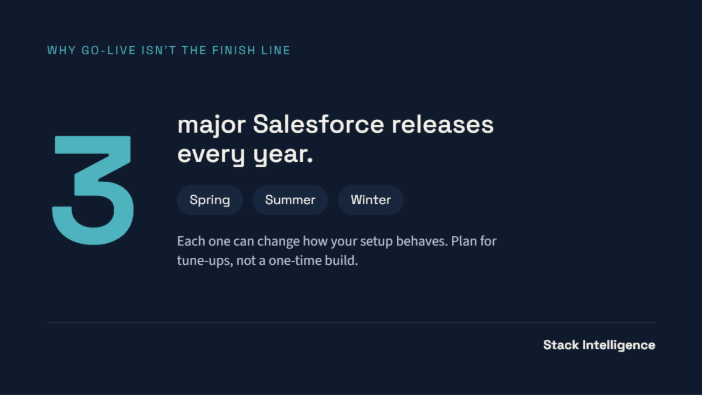
Launch day is the start of the season. The real work is getting people to use the system.
- Keep training going. New hires need it too.
- Run leadership meetings from Salesforce reports. Teams follow what the boss checks.
- Review the setup every quarter. Clean out unused fields and broken automations.
- Ask users what bugs them. Fix the small stuff fast.
What working with Stack looks like
Stack Intelligence is a Salesforce consulting team based in Beachwood, Ohio. We’re hometown friends who’ve been running plays together since Little League. Now we run them in Salesforce for public and private sector clients.
Our playbook is short. Find what’s broken. Fix it in plain English. Then check what changed. The scoreboard isn’t hours billed. For us, it’s whether the outcomes showed up.
Book a 25-minute working session. We’ll take a look at your current setup, and if you don’t need a partner, we’ll say so.
Keep exploring
Want to see how we run a rollout? Take a look at our Salesforce implementation services. It covers our process, timelines and what’s included.
Looking for a Salesforce implementation partner you’ll actually like working with? Book a working session with our team.
We share short Salesforce tips and client stories on social. Follow Stack on LinkedIn to keep up.


