What is a Salesforce consulting partner?
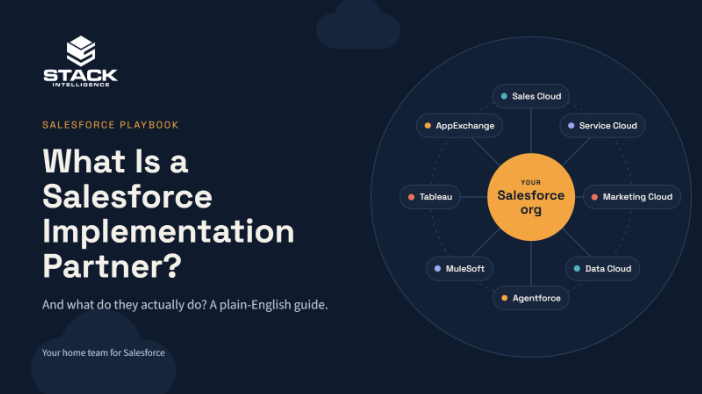
A Salesforce consulting partner is a company that helps businesses get real value out of Salesforce. They plan the setup, build it, connect it to your other systems, and help your team use it. Some also stay on after launch to keep things running.
Salesforce doesn’t do most of this work itself. Its own partner finder says 70% of Salesforce implementations benefit from the knowledge of consulting partners. So for most companies, the question isn’t whether to use a partner. It’s which one.
Why does the choice matter so much?
Because Salesforce can be set up a hundred different ways. A good partner sets it up the way your business actually works. A poor fit builds what was easy for them, and you end up paying twice: once to build it, and again to fix it.
That’s why, at Stack Intelligence, we often begin with a Salesforce health check. It shows what’s working, what’s broken, and what’s worth fixing first, before anyone signs up for a big project.
Consulting partner or implementation partner?
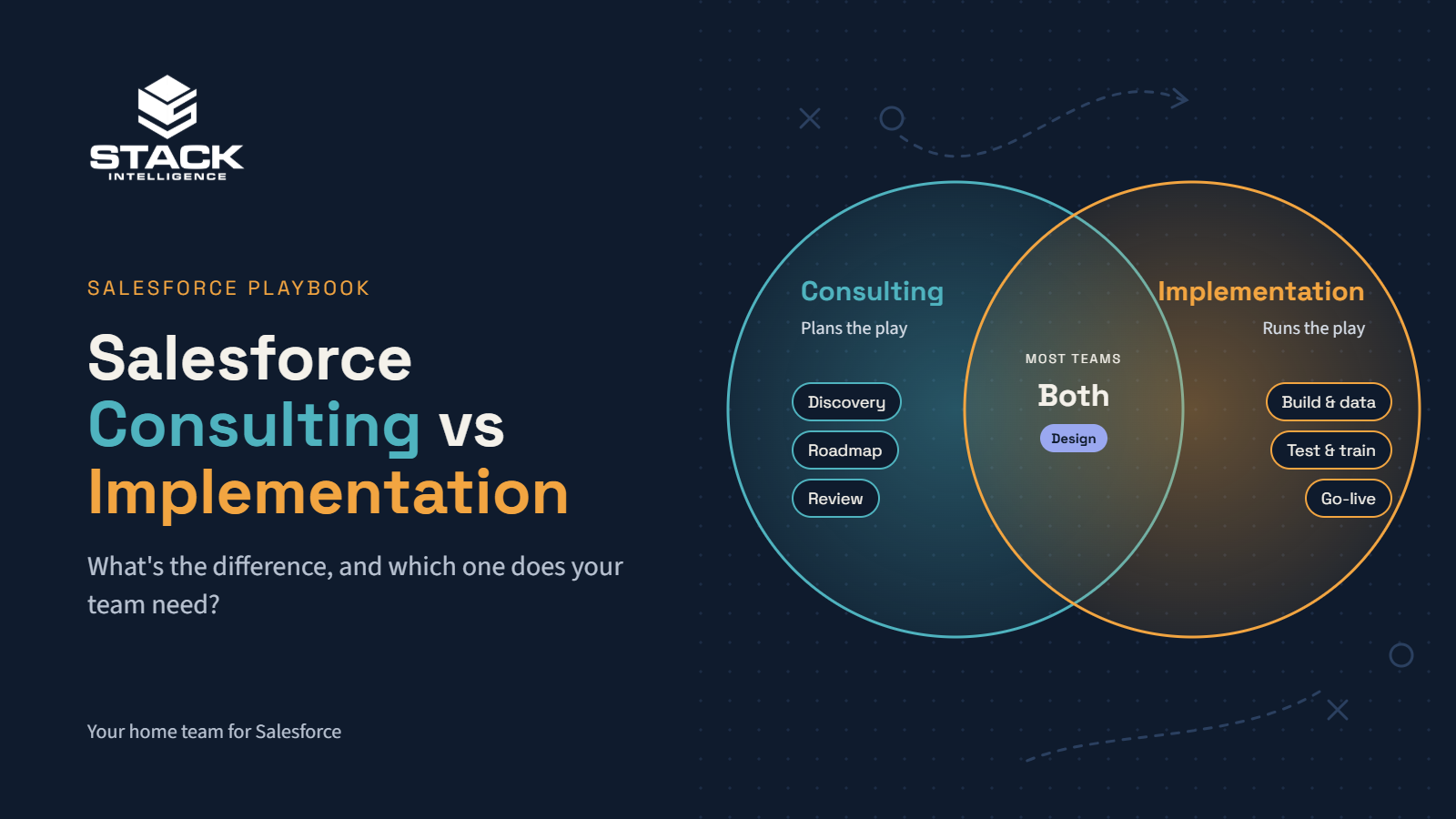
The terms overlap. Consulting is more about deciding what to build and why. Implementation is more about building it. Most good partners do both. We break down the difference between Salesforce consulting vs. implementation, and if you’re mainly hiring for a build, see how to choose a Salesforce implementation partner.
How do you choose a Salesforce consulting partner? 10 things to look for
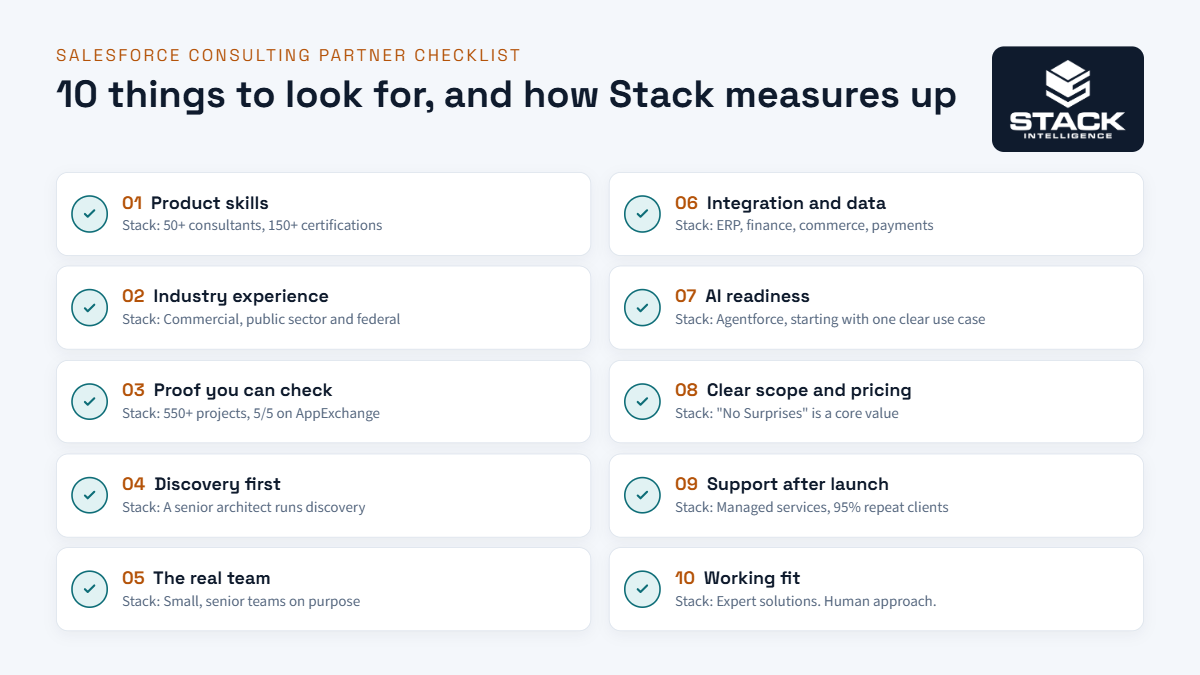
Here’s the checklist we’d use if we were on your side of the table. Under each one, we’ve added how Stack handles it, so you can hold us to the same standard.
1. Skills in the Salesforce products you use
Salesforce is a big family of products. Someone great at Marketing Cloud may know little about Revenue Cloud. Ask which products the partner works on most, and which certifications the people on your project hold.
Salesforce itself now rates consulting partners this way. In its FY27 Consulting Partner Program, each area of expertise is measured by certifications, completed projects, and customer satisfaction.
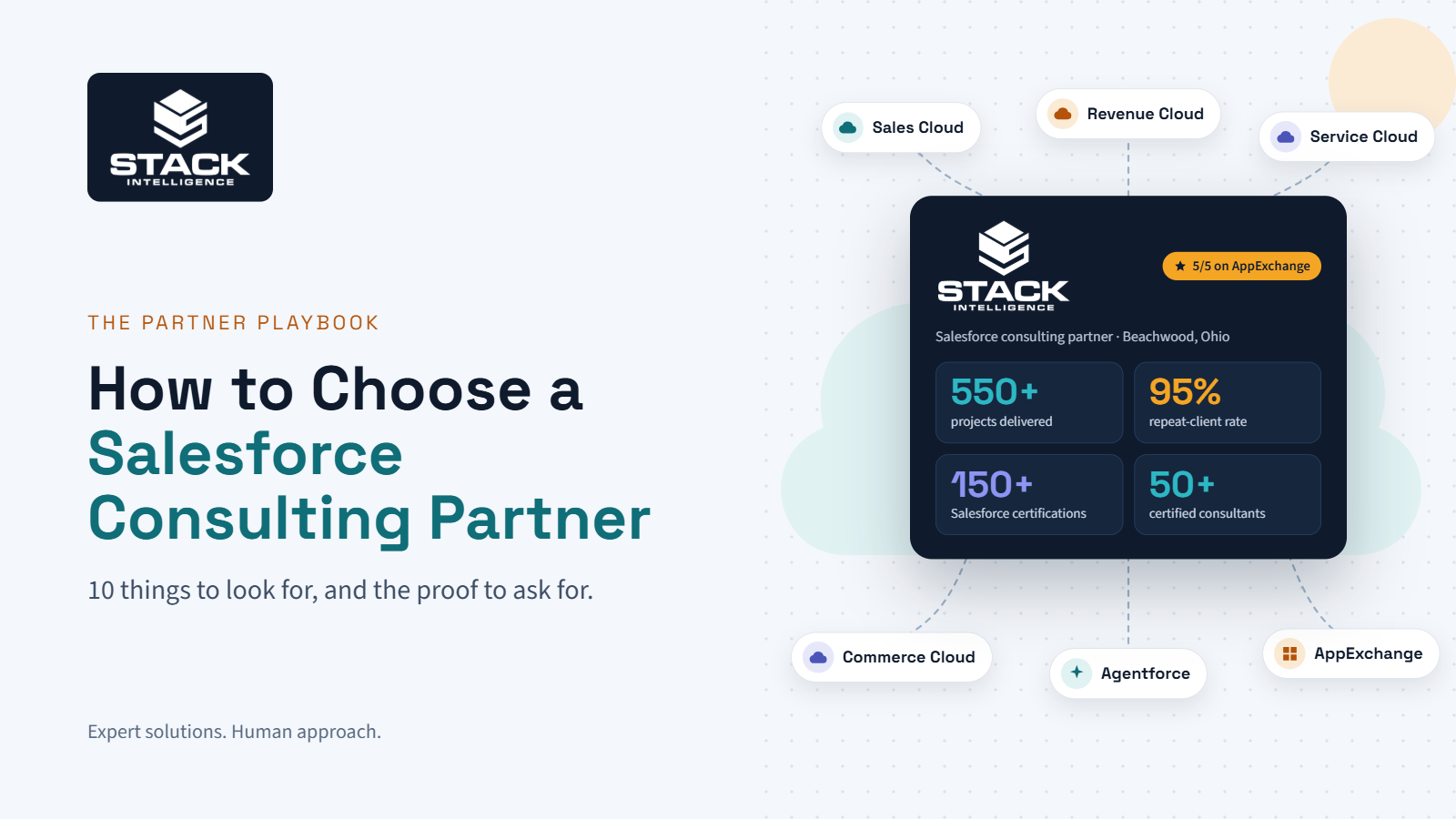
How Stack handles it: Our 50+ consultants hold 150+ Salesforce certifications, including CPQ Specialist and Revenue Cloud Consultant. We go deep in Revenue Cloud and CPQ migration, Sales Cloud, Service Cloud, Commerce Cloud, and Agentforce. If your project falls outside those, we’ll tell you.
2. Experience in your industry
A partner who knows your industry asks better questions on day one. They already know how a manufacturer prices parts, or how a healthcare team books appointments. That saves weeks.
How Stack handles it: We work across manufacturing, high tech, financial services, healthcare, retail, automotive, real estate, education, and the public sector.
3. Proof you can check
Anyone can say they’re great. Look for proof you can verify. On AppExchange, you can filter consultants by product, industry, location, and ratings, and read Verified Project Reviews from other customers. Ask for case studies, and ask to speak with a past client.
How Stack handles it: We’ve delivered 550+ projects, and clients rate us 5/5 on Salesforce AppExchange. Our case studies show real numbers. Brave Mobility’s B2B Commerce store went live in 8 weeks, and new regions now open in 1 to 2 weeks instead of 4 to 6 months. Zonar Systems moved two business units onto one quoting process in about 20 weeks. We’re also in a multi-year Salesforce partnership with the Florida Department of Financial Services.
4. They ask about your business before your software
A good partner wants to know how you make money, where deals get stuck, and what your team hates doing. A weak one jumps straight to features and licenses.
How Stack handles it: A senior architect runs discovery on every project. Configuration only starts once you’ve agreed to the plan. Our first call is a 25-minute working session on one real problem, not a slide deck.
5. You know who will actually do the work
Some firms send senior people to win the deal, then hand the project to a junior team you’ve never met. Ask who will be on your project, what they’ve built, and how much of their time you’ll get.
How Stack handles it: We keep project teams small and senior on purpose. Fewer people in the room means faster calls and one clear owner for the result. You work directly with the architects and developers doing the build.
6. Integration and data skills
Salesforce rarely works alone. It has to talk to your ERP, billing tool, website, or warehouse. Many projects slip because of messy data and weak integrations, not because of Salesforce itself. Ask how the partner handles data migration and which integration tools they use.
How Stack handles it: Our Salesforce integration services team picks the lightest tool that will hold up. Our guide to MuleSoft vs APIs vs Salesforce Connect shows how we think about it.
7. Ready for AI and Agentforce
Salesforce is putting AI agents into almost every product. Your partner should be able to tell you where an agent would help, where it wouldn’t, and what your data needs first. Salesforce’s own partner program now puts a strong focus on Agentforce.
How Stack handles it: We help clients pick a first Agentforce use case that’s small, clear, and backed by clean data. Read What Is Agentforce? for how we approach it.
8. Clear scope and honest pricing
You should know what’s included, what isn’t, and what happens when things change. Vague proposals turn into surprise change orders.
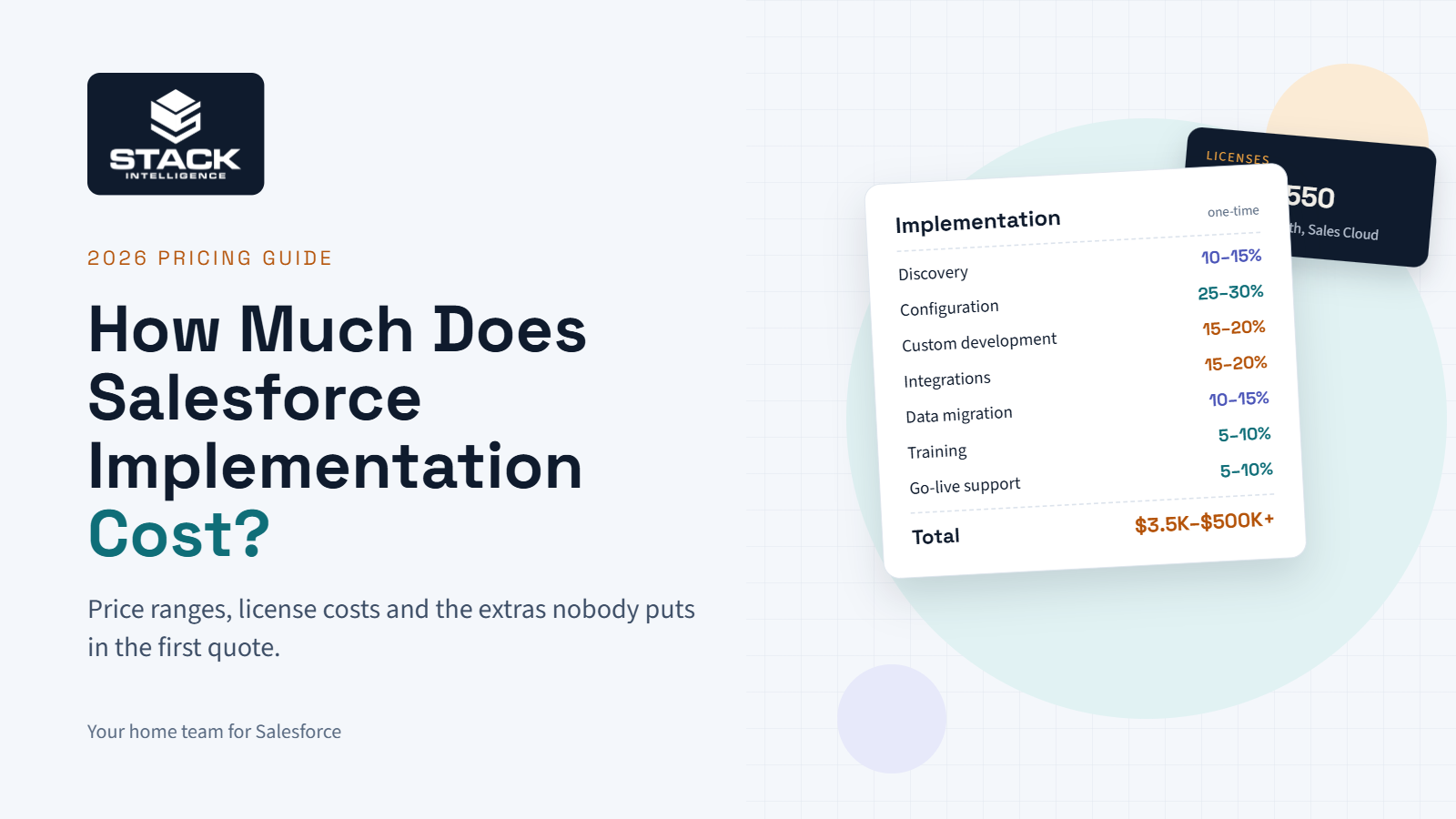
How Stack handles it: One of our core values is “No Surprises.” If a risk, a delay, or a change is coming, you’ll hear it from us first, and early. Our Salesforce implementation cost guide explains what drives the price, so you can budget before you talk to anyone.
9. Support after go-live
Launch day isn’t the finish line. Salesforce ships three major releases a year, your business changes, and users find new needs. Ask what support looks like six months after launch.
How Stack handles it: Our Salesforce managed services team covers admin work, development, optimization, and roadmap planning after launch. It’s a big reason 95% of our clients come back for their next project.
10. A team you actually like working with
You’ll talk to this team every week, sometimes for months. They should explain things simply, tell you bad news early, and be easy to reach. Trust your gut on this one.
How Stack handles it: Our motto is “Expert solutions. Human approach.” We keep the jargon low, the updates honest, and the ego at the door.
The 10 things at a glance
| What to look for | What to ask | Good sign |
|---|---|---|
| Product skills | Which certifications does my project team hold? | Names and certs, not a company total |
| Industry experience | What have you built for companies like us? | Specific examples |
| Proof | Can I read reviews and talk to a past client? | Verified reviews and real references |
| Discovery first | What do you need to know about our business? | Lots of questions before a proposal |
| The real team | Who will do the work day to day? | You meet them before you sign |
| Integration and data | How will you move and connect our data? | A clear plan and tool choice |
| AI readiness | Where would Agentforce help us first? | A small, honest first use case |
| Scope and pricing | What’s not included? | Plain-English scope, risks flagged |
| Support after launch | What happens after go-live? | A clear support plan |
| Working fit | How do you share bad news? | Straight answers |
What red flags should you watch for?
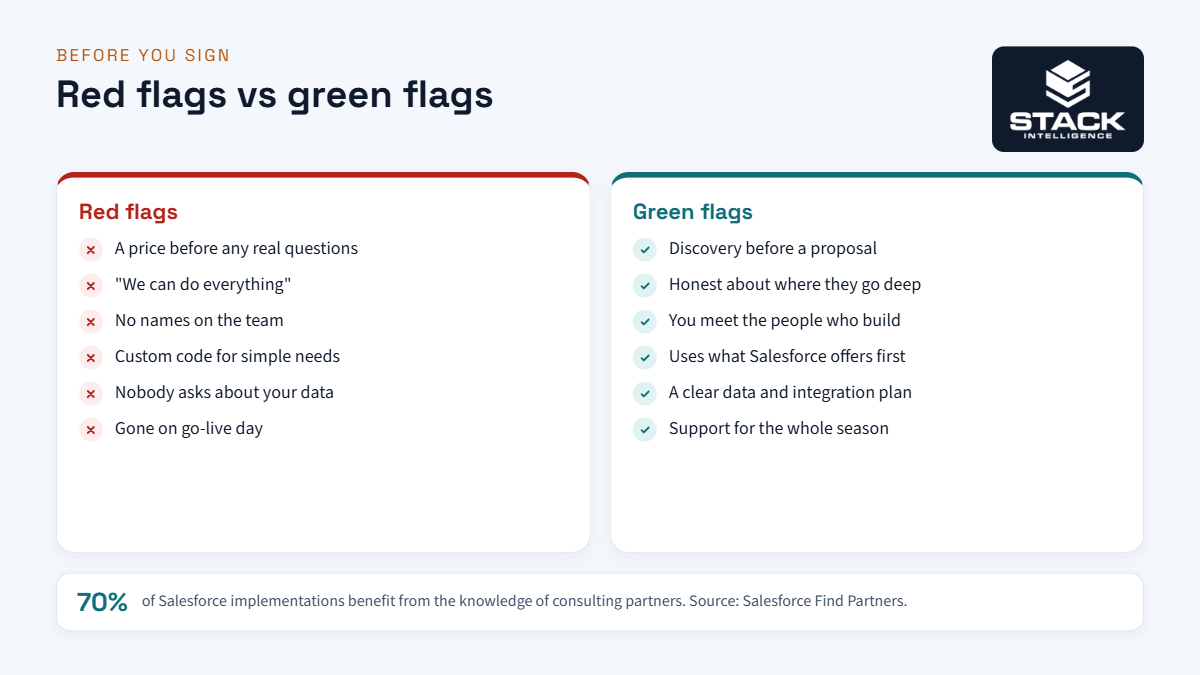
Some warning signs show up early, if you know where to look.
- A proposal before any real questions. If they priced your project after one call, they’re guessing.
- “We can do everything.” Nobody is deep in every Salesforce product. Honest partners tell you where they’re strongest.
- No names on the team. If they can’t tell you who’ll do the work, assume it’ll be whoever is free.
- Lots of custom code for simple needs. Heavy code is harder and more expensive to maintain. Good partners use what Salesforce already offers first.
- Silence about data. If nobody asks about the state of your data, the trouble is just delayed.
- No plan for after launch. A partner who disappears on go-live day leaves you holding a system nobody fully understands.
What questions should you ask a Salesforce consulting partner?
Bring these to your first call. The answers will tell you a lot.
- Which Salesforce products do you work on most?
- Who exactly will work on our project, and what certifications do they hold?
- Can you show a project like ours, and can we talk to that client?
- How do you handle data migration and integrations?
- Where would AI or Agentforce help us, and where wouldn’t it?
- What’s not included in your scope?
- How do you handle changes once the project starts?
- What does support look like after go-live?
One more tip. Salesforce’s partner finder notes that Salesforce makes no warranties or guarantees about any consulting partner. Their listings help you build a shortlist. Your own questions make the final call.
Why do teams choose Stack as their Salesforce consulting partner?
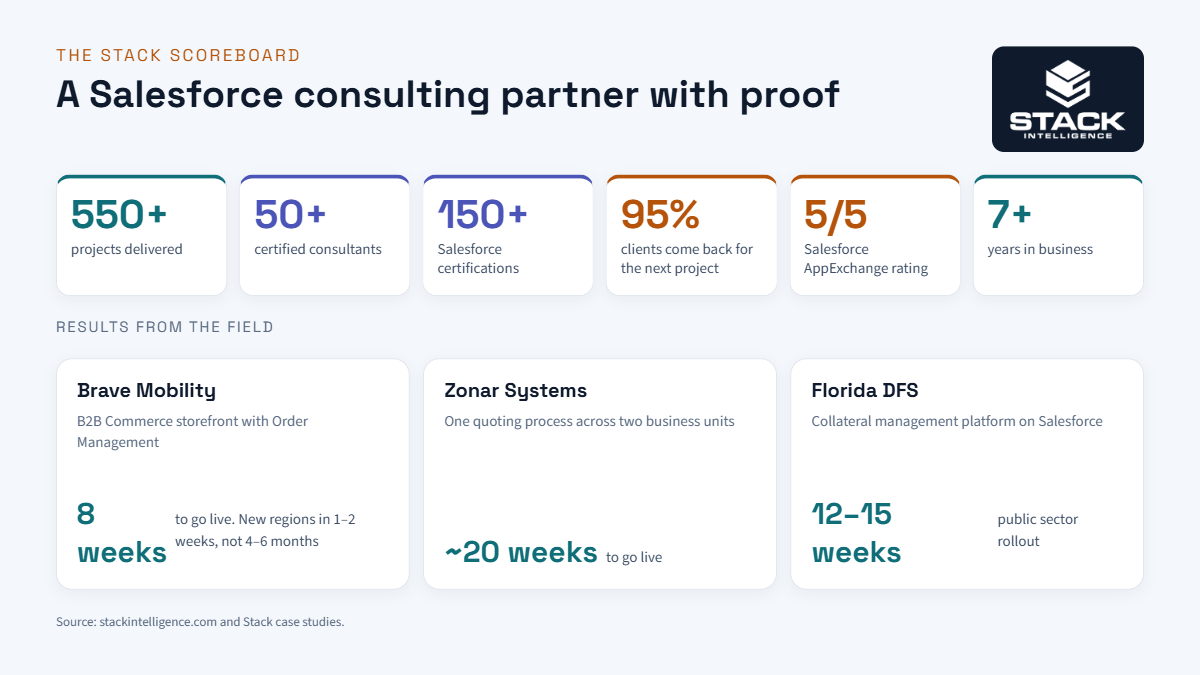
Stack Intelligence is a Salesforce consulting partner based in Beachwood, Ohio. We’ve been in business since 2018 and became a Salesforce Consulting Partner in 2023. We’re hometown friends at heart, and we run every project like a team that wants to win together.
The scoreboard so far:
| Stat | Stack Intelligence |
|---|---|
| Projects delivered | 550+ |
| Certified Salesforce consultants | 50+ |
| Salesforce certifications | 150+ |
| Clients who come back for the next project | 95% |
| Salesforce AppExchange customer satisfaction | 5/5 |
| Years in business | 7+ |
Those numbers come from how we play.
Quote-to-cash is our specialty. Revenue Cloud, billing, and CPQ migration make up a big share of our work, and we map every pricing rule and approval before a single record moves. If Revenue Cloud is on your roadmap, that’s our home field.
One team covers the whole season. Strategy through our Salesforce consulting services. The build through our implementation services. Connections to your ERP, finance, commerce, and payment tools through our integration services. And steady support after launch through managed services. Nothing gets handed to another vendor halfway through.
We work across commercial, public sector, and federal clients, from a B2B storefront that went live in 8 weeks to a multi-year Salesforce rollout for the Florida Department of Financial Services. See the full highlight reel in our case studies.
Book a 25-minute working session. Bring one real Salesforce problem. We’ll work on it with you live, and you’ll see exactly how we’d play it, before you commit to anything.
Keep exploring
Still sorting out roles? Read Salesforce consulting vs. implementation and how to choose a Salesforce implementation partner.
Planning a budget? Our Salesforce implementation cost guide walks through what drives the price.
Looking at specific products? Start with What Is Salesforce Revenue Cloud?, What Is Agentforce?, and Salesforce Revenue Cloud vs CPQ.
Want to see how we’d tackle your setup? Book a working session, or follow us on LinkedIn for Salesforce tips and client wins.